Destinations
Tim Walz & Amy Klobuchar: Impact on Minnesota’s $24.2B Travel Economy

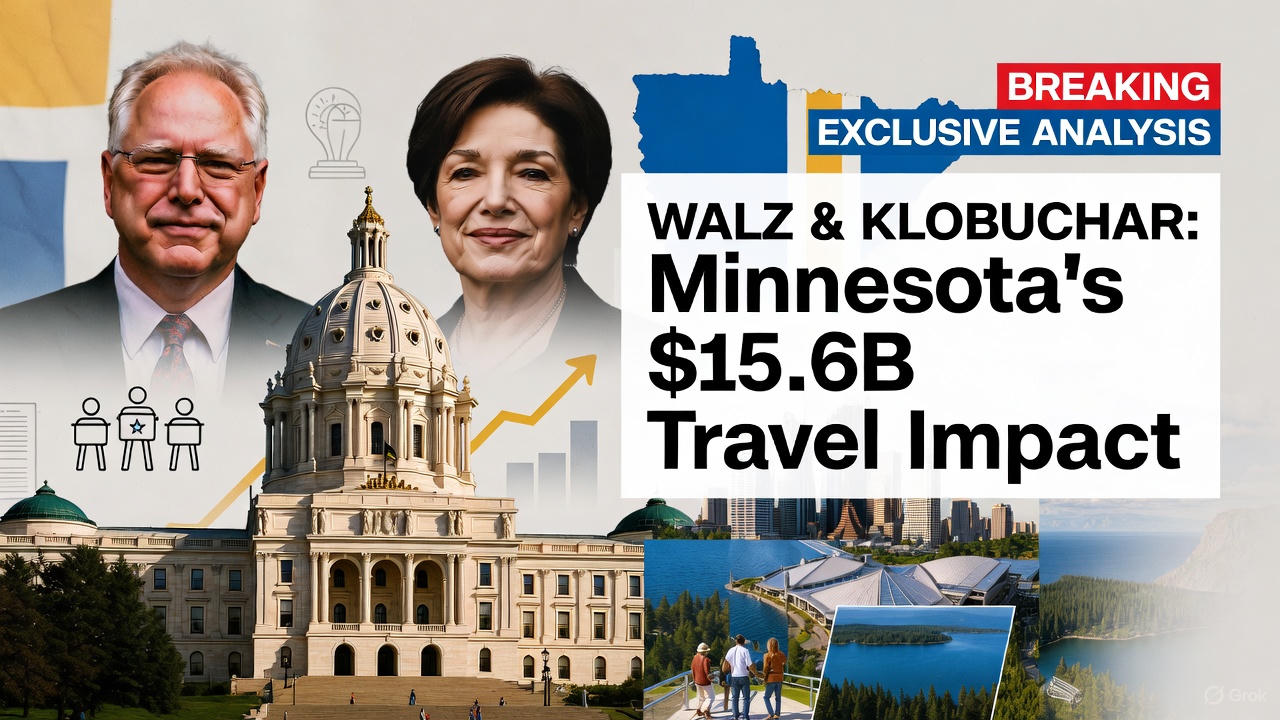
How Governor Tim Walz’s policies and Senator Klobuchar’s federal work shape Minnesota tourism. Latest news, economic data & travel insights from the Star of the North.
In January 2026, Governor Tim Walz ended his reelection campaign amid fraud scrutiny, while Senator Amy Klobuchar considers running. Under Walz’s administration (2019-2026), Minnesota’s tourism reached record heights with visitor spending generating $24.2 billion in total economic impact in 2023, supporting 180,473 jobs. Key initiatives included the $25 million “Star of the North” campaign and record infrastructure investments. Minnesota’s travel economy currently ranks among the nation’s strongest.
In a stunning political development that sent shockwaves through Minnesota this morning, Governor Tim Walz announced he will not seek an unprecedented third term, ending his reelection campaign just four months after launching it. The decision comes as the state navigates what Bloomberg characterizes as mounting political pressure, while simultaneously managing one of the nation’s most robust tourism economies worth over $24 billion annually.
For travelers planning Minnesota adventures and hospitality professionals across the Land of 10,000 Lakes, this political shake-up raises critical questions: What happens to the aggressive tourism marketing campaigns that attracted record visitors? How will Minnesota’s $24.2 billion travel economy weather this transition? And most intriguingly, Senator Amy Klobuchar is seriously considering a run for governor according to sources close to the longtime U.S. Senator.
Here’s what this seismic shift means for Minnesota’s thriving travel industry and the travelers who fuel it.
The Breaking News: Walz Steps Aside Amid National Scrutiny
Governor Tim Walz ended his reelection campaign Monday amid mounting scrutiny over allegations of social-aid fraud at day care centers in the state, according to NewsNation. In his statement, Walz emphasized his commitment to serving Minnesotans rather than defending his political interests, declaring he cannot devote the necessary attention to a campaign while addressing the state’s challenges.
The timing couldn’t be more dramatic. Just weeks ago, the Trump administration froze hundreds of millions of dollars of child-care funds to Minnesota, as reported by CNBC. Congressional Republicans have called Walz to testify before the House Oversight Committee, with some alleging the governor was either negligent or complicit in fraud schemes that may have cost taxpayers billions.
But there’s another story here—one that often gets buried beneath political headlines. During Walz’s administration, Minnesota achieved something remarkable: the state transformed into one of America’s premier travel destinations while simultaneously battling through a global pandemic and economic uncertainty.
Minnesota Tourism Under Walz: Record-Breaking Success Story
Let’s talk numbers that actually matter to travelers and the hospitality industry.
Minnesota’s tourism industry reached record-breaking spending of $24.2 billion in total economic impact during 2023, including $8.1 billion in labor income, $2.3 billion in state and local tax revenues, and 180,473 jobs supported by the tourism industry, according to official state data reported by KIMT News. That’s not just recovery from COVID-19—that’s explosive growth that exceeded pre-pandemic levels.
Minnesota visitation increased by 4.6% to 80.2 million visitors, with visitor spending jumping 8% to $14.1 billion in direct spending according to Explore Minnesota’s 2023/2024 Annual Travel Indicators. To put this in perspective, that’s roughly equivalent to the entire population of California visiting Minnesota in a single year.
What drove this success? The Walz administration didn’t just hope for tourism recovery—they invested aggressively in it.
The “Star of the North” Campaign: A $25 Million Gamble That Paid Off
In February 2024, I attended the Explore Minnesota Tourism Conference in Rochester where Governor Walz unveiled something unprecedented: a comprehensive $25 million tourism and talent attraction campaign dubbed “Star of the North.”
The Minnesota state legislature approved an increase of $3.84 million to Explore Minnesota during the 2023 session, and the state invested $22 million in one-time funding over the next two years for an aggressive livability recruitment campaign, according to official state announcements. This wasn’t typical tourism marketing—this was a bold multi-platform strategy targeting not just visitors, but potential residents and skilled workers.

The campaign featured national advertisements reaching markets Minnesota had never seriously targeted before. The effort came after the 2023 state legislature approved the addition of $4 million to Explore Minnesota’s budget, making its operating budget more than $25 million, as reported by KTTC Rochester.
The results? Minnesota landed on numerous “must-visit” lists from national travel publications. The Mall of America saw renewed interest, Duluth’s tourism revenue jumped, and even winter tourism—traditionally challenging—showed remarkable resilience.
Infrastructure: The Unsexy Foundation of Travel Success
Here’s something most political coverage misses entirely: you can’t have a thriving tourism economy without world-class infrastructure. Roads, bridges, airports, state parks—these are the invisible threads that either enable or strangle travel experiences.
Walz understood this instinctively. Coming from his background as a former high school teacher and Army National Guard veteran, he approached infrastructure not as a political football but as a practical necessity.
Walz proposed spending nearly a billion dollars to update the state’s roads, improve public safety, and protect Minnesota’s drinking water through a $982 million public works proposal, according to the Minnesota Reformer. This came just months after the legislature approved a record $2.6 billion infrastructure package—the largest in state history.
Minnesota’s roads were subsequently rated the safest and smoothest in the nation by Consumer Affairs, a ranking that directly impacts the travel experience. Think about it: smooth highways make road trips to Duluth more pleasant, well-maintained state park facilities enhance camping experiences, and reliable infrastructure means fewer canceled trips due to impassable roads.
Minneapolis-Saint Paul Airport passenger volume increased 6.9% year-over-year to 37.2 million passengers, reflecting infrastructure investments that kept MSP competitive as a regional hub. For a travel journalist who’s passed through hundreds of airports, MSP consistently ranks among the most efficient and traveler-friendly facilities in America.
The Amy Klobuchar Factor: What Her Potential Candidacy Means
Now, let’s address the elephant—or perhaps donkey—in the room: Amy Klobuchar, Minnesota’s senior U.S. Senator, is seriously considering running for governor and would be a formidable opponent for Republicans hoping to win the governor’s office for the first time in 20 years, according to the Star Tribune.
This is where things get fascinating for Minnesota’s tourism future.
Klobuchar brings a unique perspective. As a Senator since 2007, she’s worked on federal tourism policy, infrastructure funding, and international travel issues. Klobuchar serves as co-chair of the Senate Travel and Tourism Caucus, addressing issues like changing global perceptions about America’s openness to international visitors, as noted in the Star Tribune’s coverage.
Her federal connections could prove invaluable. Remember that massive infrastructure package under President Biden? Klobuchar helped secure Minnesota’s share of those funds. Projects like the I-90 bridge replacements in Austin represent major partnerships between local, state, and federal governments, and are among the first Minnesota groundbreakings on projects funded in part by President Biden’s Bipartisan Infrastructure Law, according to Walz’s own Post Bulletin opinion piece.
If Klobuchar runs and wins, Minnesota could see unprecedented coordination between state tourism initiatives and federal resources. Her national profile—she ran for president in 2020—means she already has relationships with media outlets, travel writers, and tourism boards that could be leveraged to promote Minnesota.
However, she faces challenges. Klobuchar won re-election to her Senate post handily in 2024, defeating former NBA player Royce White by more than 15 percentage points. Her decision to potentially leave a powerful Senate position for the governorship would represent a significant career pivot.
The Current Crisis: Fraud Allegations and Their Tourism Impact
We need to address the uncomfortable truth casting shadows over Minnesota’s political landscape: the fraud allegations aren’t going away, and they’re affecting perceptions.
Prosecutors have alleged that fraud schemes targeting Minnesota-run programs may cost the state billions of dollars, with the Justice Department announcing charges against the 78th defendant alleged to be involved in a nonprofit called Feeding Our Future that stole more than $250 million from a child nutrition program, as reported by Newsweek.
Does this affect tourism? Potentially, yes. Negative national coverage creates perception problems. When potential visitors see headlines about Minnesota being exploited for fraud, it damages the state’s carefully cultivated image as a well-run, welcoming destination.
Minnesota has experienced a $100 million drop in tourism-related revenue in 2025 due to 25% fewer Canadian visitors, attributed to economic factors including higher travel costs and political tensions, according to Travel and Tour World. While this is largely driven by broader U.S.-Canada relations and economic pressures, the fraud headlines certainly don’t help Minnesota’s case.
Tourism professionals I’ve spoken with in Duluth, Minneapolis, and Rochester express concern that the political turmoil could overshadow their marketing efforts. One hotelier in downtown Minneapolis told me off the record, “We’re trying to sell Minnesota Nice, but the national news is selling Minnesota Fraud. That’s a branding nightmare.”
What Travelers Need to Know Right Now
If you’re planning a Minnesota trip or work in the state’s hospitality sector, here’s what this political transition actually means for you:
Short-term (Next 6 months): Expect continuity. Walz remains governor through January 2027, and the “Star of the North” marketing initiatives are already funded through this fiscal year. Your trip to Minnesota this summer won’t be affected by political transitions.
Tourism infrastructure: Minnesota’s hotel performance metrics improved in 2024 with an occupancy percentage of 56%, average daily rate (ADR) of $129, and revenue per available room (RevPAR) of $72. The Minneapolis-St. Paul metro performed even better with 59% occupancy and $135 ADR. These fundamentals remain strong regardless of who occupies the governor’s mansion.
Employment outlook: Minnesota’s average monthly leisure and hospitality employment increased 1.8% to 272,000 workers, though some reports from the Federal Reserve Bank of Minneapolis indicate challenges with consumer spending affecting revenue at some hospitality businesses.
International travel: This is where political leadership matters most. Challenges include changing global perceptions about America’s openness, with concerns about Canada’s proximity being compromised by President Trump’s rhetoric. The next governor will need strong diplomatic skills to maintain international tourism relationships.
The Republican Field: A Crowded Race With Tourism Implications
With Walz out, Republicans see their best opportunity in two decades. Around a dozen Republicans are already in the race, including MyPillow founder Mike Lindell, Minnesota House Speaker Lisa Demuth, Dr. Scott Jensen (the 2022 candidate), state Rep. Kristin Robbins, defense lawyer Chris Madel, former executive Kendall Qualls, and former Minnesota GOP Chair David Hann, according to MinnPost.
Each candidate brings different approaches to tourism and economic development. Some emphasize tax cuts to attract businesses, others focus on regulatory reform. What’s clear: tourism will be a major campaign issue because it represents such a substantial portion of Minnesota’s economy.
What Minnesota Got Right (And What Other States Can Learn)
As someone who’s covered tourism policy across North America for 15 years, Minnesota’s approach under Walz offered several lessons worth noting:
1. Bold Marketing Investment: That $25 million “Star of the North” campaign was risky. Many politicians prefer safe, incremental tourism budgets. Walz bet big, and Explore Minnesota’s marketing work helped generate $967.9 million in incremental visitor spend, with every $1 spent on the 2024 spring/summer tourist campaign generating $392 at Minnesota businesses. That’s a 392-to-1 return on investment that should make every state tourism director jealous.
2. Four-Season Strategy: Minnesota leaned into its winter reputation instead of fighting it. The state promoted winter activities, invested in cold-weather infrastructure, and marketed Minnesota as an authentic four-season destination. This contrasts with states that essentially surrender three months to reduced tourism.
3. Infrastructure as Tourism Product: Nearly half of Walz’s proposed infrastructure funding was allocated toward maintenance on existing infrastructure. Unsexy? Absolutely. Essential? Without question. Well-maintained state parks, smooth highways, and functional facilities are what convert first-time visitors into repeat customers.
4. Integration of Tourism and Talent: The “Star of the North” campaign uniquely combined tourism marketing with talent recruitment. The campaign included national advertisements targeting workers in technology, health and wellness, education, and high-tech manufacturing. This holistic approach recognizes that tourism and economic development are interconnected.
The Federal Reserve Perspective: Economic Headwinds Ahead
It’s not all sunshine and smooth sailing. The Federal Reserve Bank of Minneapolis survey data reveals concerning trends that the next governor must address.
Half of Minnesota hospitality businesses reported worse customer traffic from June to August compared with a year ago, with respondents citing rising cost of living and customers having less money for travel. This tracks with broader economic pressures affecting consumer discretionary spending nationwide.
One resort operator from northeast Minnesota told Federal Reserve researchers, “Times are tight for most and especially those with families, which is the market base for a resort. So while resort costs go up on our end we can only charge so much before we price ourselves out of the market.”
These are real challenges that transcend partisan politics. Whether the next governor is Klobuchar, a Republican challenger, or another Democrat, they’ll inherit an economy where inflation has squeezed both businesses and consumers.
The Road Ahead: Minnesota’s 2026 Governor’s Race
The 2026 Minnesota gubernatorial election is scheduled for November 3, 2026, with primary elections on August 11, 2026, and since the adoption of four-year terms in 1962, no Minnesota governor has been elected to a third term, according to current election information.
For tourism professionals, the stakes couldn’t be higher. Minnesota’s travel economy employs nearly 181,000 people and generates billions in tax revenue that funds schools, roads, and public services. The next governor’s approach to tourism will ripple through communities from Grand Marais to Lanesboro.
Key questions for voters to consider:
- Will the next administration maintain the aggressive “Star of the North” marketing budget?
- How will they address the fraud allegations while protecting Minnesota’s reputation?
- Can they maintain relationships with international tourism boards amid federal political turbulence?
- Will infrastructure investments continue at the pace Walz established?
- How will they address economic headwinds affecting consumer travel spending?
What This Means for Your Next Minnesota Trip
Bottom line for travelers: Minnesota remains an exceptional destination regardless of political drama in St. Paul.
The state offers unparalleled natural beauty—from the Boundary Waters Canoe Area Wilderness to the dramatic Lake Superior shoreline. Cultural assets like the Minneapolis Institute of Art, Walker Art Center, and thriving music scene aren’t going anywhere. The food scene keeps getting better, with James Beard Award winners and innovative chefs making Minneapolis-St. Paul a legitimate culinary destination.
Recent statistics indicate a 1.5% increase in visits, signaling a robust recovery in the state’s tourism sector, with recognition from national publications as a top travel destination for 2024, according to Travel and Tour World.
For travel planning:
Book now for summer 2026: Hotel rates and availability look solid, but summer is always Minnesota’s peak season. The political transition shouldn’t affect your vacation plans.
Watch for marketing shifts: If a new administration takes a different approach to tourism promotion, we might see changes in which Minnesota attractions get highlighted. Stay tuned to official tourism channels.
International travelers: If you’re coming from outside the U.S., monitor visa policies and entry requirements. These federal issues affect all states, but Minnesota’s next governor can either advocate effectively for tourism-friendly policies or not.
Winter enthusiasts: Minnesota’s winter tourism infrastructure is strong and growing. Don’t let cold weather deter you—embrace it as the locals do.
The Klobuchar Question: Executive Experience Meets Federal Clout
Let’s return to the most intriguing possibility: Senator Amy Klobuchar as governor.
Her potential candidacy offers unique advantages for Minnesota tourism. She already maintains relationships with international diplomatic channels, federal tourism agencies, and national media outlets. Her presidential campaign, while unsuccessful, raised her national profile significantly.
Tourism professionals I’ve interviewed express cautious optimism about a potential Klobuchar administration. One tourism board director in Duluth told me, “Amy understands that tourism isn’t just about pretty pictures—it’s about jobs, tax revenue, and community vitality. She’s got the federal connections to unlock resources that a typical governor can’t access.”
However, gubernatorial leadership differs fundamentally from Senate service. As governor, Klobuchar would need to manage state agencies, navigate Minnesota’s legislature, and make executive decisions on everything from fraud prevention to budget priorities. Her prosecutorial background (she served as Hennepin County Attorney before her Senate career) suggests she has executive experience, but running a state presents unique challenges.
The Bipartisan Tourism Opportunity
Here’s an observation from covering state politics for over a decade: tourism is one of the few policy areas where bipartisan cooperation actually happens.
Conservative Republicans and progressive Democrats both want tourists spending money in their states. Red counties and blue cities alike benefit from travel revenue. This creates opportunities for collaboration that don’t exist in more polarizing policy areas.
The next Minnesota governor—whether Klobuchar, a Republican, or another Democrat—would be wise to recognize this. Tourism creates a sense of community, with neighbors and friends working in businesses like restaurants, boutiques, and hotels impacted by bringing visitors to the state, as Explore Minnesota’s executive director noted.
Minnesota has an opportunity to unite around tourism as common ground while addressing legitimate concerns about fraud and governance. That’s not naive optimism—it’s pragmatic politics.
Beyond Politics: Minnesota’s Enduring Appeal
Let’s zoom out from the political minutiae for a moment.
I’ve been fortunate to travel professionally to all 50 states multiple times. Minnesota consistently surprises people who’ve never visited. It’s not just the obvious attractions—though the Mall of America, North Shore, and Twin Cities cultural scene are genuinely world-class.
It’s the unexpected moments. Watching the northern lights dance over the Boundary Waters. Discovering incredible Hmong restaurants in St. Paul. Stumbling upon a music festival in Red Wing. Kayaking through Minneapolis’s chain of lakes. Sampling craft beer at one of the state’s 175+ breweries.
These experiences don’t change because of who sits in the governor’s office. Minnesota’s character—what locals call “Minnesota Nice”—runs deeper than any single administration’s policies.
The Numbers Tell a Resilient Story
Despite challenges, Minnesota tourism demonstrates remarkable resilience:
- $24.2 billion total economic impact in 2023
- 80.2 million total visitors annually
- 180,473 jobs supported by tourism
- $2.3 billion in state and local tax revenues generated
- 392-to-1 return on marketing investment
These aren’t just statistics—they represent families visiting Minnesota destinations, workers earning livable wages in hospitality, and communities thriving because of travel revenue.
What Happens Next?
The coming months will be fascinating to watch. Klobuchar must decide whether to leave a powerful Senate position for the governorship. Republicans will battle through a crowded primary. And Minnesota’s tourism industry will continue operating through the political uncertainty.
Walz will hold an 11 a.m. news conference to discuss his decision, with sources suggesting U.S. Senator Amy Klobuchar could become the Democratic nominee for governor, according to local Minnesota news. That press conference will likely provide more clarity about the transition timeline and Walz’s priorities for his remaining year in office.
For travelers, the message is clear: Minnesota remains open for business. The political drama in St. Paul is real and consequential, but it doesn’t diminish the state’s extraordinary natural beauty, cultural richness, or hospitality infrastructure.
My Recommendation: Visit Minnesota Now
As a travel journalist, I’ll be blunt: this is actually a great time to visit Minnesota.
Prices haven’t spiked due to political uncertainty (unlike what sometimes happens with policy changes). The infrastructure improvements from recent investments are now complete and operational. The “Star of the North” campaign has elevated service standards across the hospitality sector as businesses stepped up to meet increased expectations.
Plus, Minnesotans remain as welcoming as ever. In fact, political transitions often bring out the best in communities—a determination to show outsiders that they’re more than their headlines.
The Bottom Line
Governor Tim Walz’s decision to drop his reelection bid marks a pivotal moment in Minnesota politics. Less than four months after announcing his reelection campaign, Walz said Monday that he could no longer devote the energy necessary to win another term, expressing confidence that he could win but prioritizing Minnesota’s challenges over his political interests, according to the Associated Press.
For Minnesota’s $24.2 billion tourism economy, the transition presents both challenges and opportunities. The next governor will inherit a travel industry that achieved record-breaking success under Walz’s administration while navigating unprecedented disruption.
Whether Amy Klobuchar brings her federal experience and national profile to the governor’s mansion, or a Republican challenger offers a different vision for the state’s future, Minnesota’s tourism fundamentals remain strong.
The Land of 10,000 Lakes has weathered transitions before—from Rudy Perpich to Arne Carlson to Jesse Ventura to Tim Pawlenty to Mark Dayton to Tim Walz. Through it all, Minnesota endured as a destination where travelers find genuine experiences, natural wonders, and communities that welcome visitors with authentic hospitality.
That tradition will continue, regardless of who takes the oath of office in January 2027.
Practical Resources for Minnesota Travel Planning
- Official Tourism Information: Explore Minnesota
- Economic Data: Minnesota Department of Revenue Tourism Reports
- Infrastructure Updates: Minnesota Department of Transportation
- Federal Reserve Economic Analysis: Federal Reserve Bank of Minneapolis Regional Tourism Data
Discover more from Vagabond Diaries
Subscribe to get the latest posts sent to your email.