
Destinations
A Trainspotter’s Dream: Our Own Station on England’s Most Scenic Railway

“The railway is not simply a celebration of heritage or tourism, but has been crucial in connecting communities.” — Michael Portillo, Honorary President, Friends of the Settle-Carlisle Line
The Listing That Stopped a Platform Full of Cynics in Their Tracks
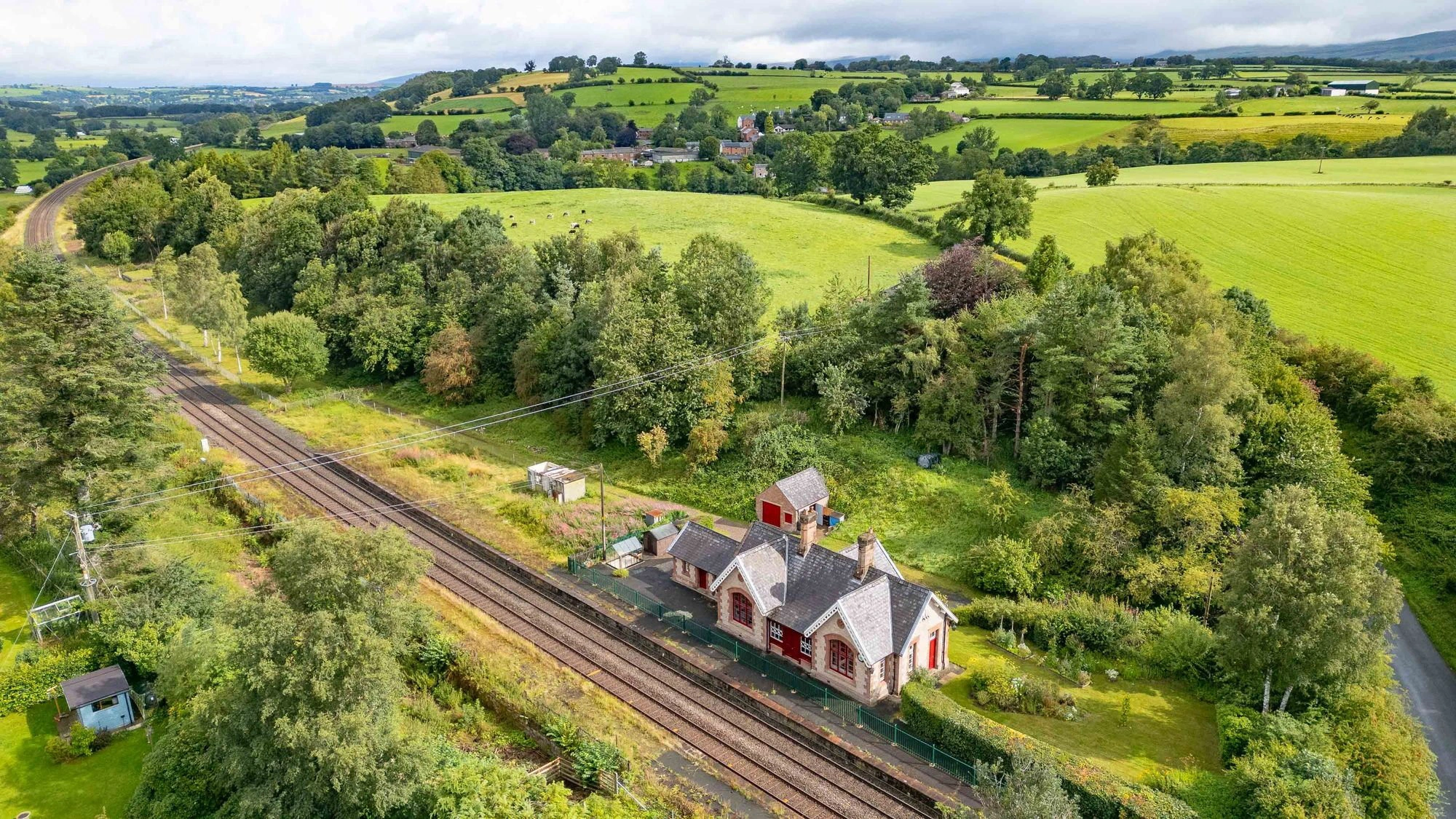
There is a particular kind of property listing that transcends the dreary calculus of square footage and commuter belts to become, instead, a cultural provocation. The Old Station at Little Salkeld, a former halt on the Settle–Carlisle line now offered to the market for the first time in twenty-eight years at £375,000, is exactly such a listing. It does not merely offer a home. It offers an argument—about how we want to live, what we value in built heritage, and whether the most romantic real estate decision a person can make in 2026 might just be to install themselves beside a working Victorian mainline in the Eden Valley of Cumbria and let the world’s finest scenic railway deliver its theatre directly to the garden gate.
I will confess that when the details first crossed my desk in late summer 2025, I fully expected the kind of damp-lipped estate-agent prose that turns listed buildings into liabilities. What I found instead was a building of such particularity—Eden sandstone walls two feet thick, a Westmorland slate roof the colour of storm clouds, gothic windows with the austere geometry of a country church—that the prose, for once, did not need to work hard. The building speaks with the unhurried authority of the Midland Railway Company, which built it in the 1870s as one stop on what would become, a century and a half later, Lonely Planet’s pick for the most scenic railway route in Europe.
This is not an article about a house. It is an article about an idea: that the most intelligent, most emotionally alive property investment available to the globally mobile buyer of 2026 may be a converted Victorian station on one of the world’s great railways, priced at a level that makes a studio flat in Zone 2 look like an act of financial self-harm.
The Line That Nearly Disappeared—and Now Refuses to Stop
To understand why the Old Station at Little Salkeld carries a weight well beyond its £375,000 asking price, you must first understand what almost happened to the Settle–Carlisle line itself. In the mid-1980s, British Rail sought closure. The route was deemed uneconomical, its viaducts too expensive, its passenger numbers too thin. Activists, historians, parish councils, and a remarkable coalition of ordinary Britons who had never attended a public inquiry in their lives descended on the process. In April 1989, the closure was rejected. The line was saved. Little Salkeld station had already closed to passengers in 1970—well before the reprieve campaign—but the line it served would go on to carry nearly one million passenger journeys in 2025, a figure the railway’s custodians expect to surpass in 2026 as the line celebrates its 150th anniversary of carrying passengers.
That anniversary is not merely symbolic. The Settle Carlisle Railway Development Company has chartered a Battle of Britain Class locomotive—the ‘Tangmire’—to haul heritage carriages from Carlisle to York on Bank Holiday Monday, 25 May 2026, with stops at Appleby, Settle, and Skipton. A Ride to Stride walking festival unfolds across late April and early May, using the railway as its spine. The Ribblehead Station café, that improbable outpost of civilisation beneath one of Victorian engineering’s grandest viaducts, has completed a full refurbishment timed to open for the 2026 season. The Settle–Carlisle Railway Development Company was named a TripAdvisor Travellers’ Choice award winner last year, placing it among the top ten per cent of travel experiences worldwide. The line is not fading. It is expanding into its mythology.
For the buyer of the Old Station at Little Salkeld, this anniversary moment is a compounding asset. Heritage railways in anniversary years attract column inches, travel features, documentary commissions, and the kind of word-of-mouth that no marketing budget can replicate. To own a Victorian station building on England’s most scenic railway, in the year that railway turns one hundred and fifty, is to hold a front-row seat at a cultural event that will not come again in one’s lifetime.
What You Actually Get: A Victorian Masterpiece, Room by Room
The property sits on two acres of landscaped grounds in Little Salkeld, a village of gentle improbability nestled in the Eden Valley near Penrith. The building itself is a showcase of Victorian craftsmanship: locally quarried Eden sandstone, walls substantial enough to insulate against both Cumbrian winters and the passing of trains, a Westmorland slate roof, and gothic windows that lend the structure a devotional quality entirely appropriate for a railway age that worshipped engineering as previous centuries had worshipped cathedrals.
Inside, the rooms are a palimpsest of function and memory:
- The entrance hall—once the station lobby—retains its original flagstone floor, exposed stone walls, and ornate arched windows. The light falls differently here than in any conventionally-built space; it has the quality of a place that has processed thousands of departures.
- The living room, carved from the old waiting room and ticket office, retains the stone-edged recess that once framed the ticket hatch. It is one of those domestic details that could not be invented, only inherited.
- The main bedroom occupies the former stationmaster’s office. Here, a William Potts clock mechanism—the timekeeping heart of the station—has been preserved in situ. One wakes not to an alarm but to the ghost of Victorian punctuality.
- The remaining bedrooms were in former lives the fuel store, lamp room, and ladies’ cloakroom, while bathrooms and kitchen repurpose the gents’ and porter’s rooms. The building has been lived in continuously since its conversion in the late 1980s. It has, in other words, three owners in its entire history: the Midland Railway Company, whoever first had the vision to make it a home, and the family who has held it for the past twenty-eight years. Some properties accumulate; this one distills.
Outside, the two acres encompass landscaped gardens, a greenhouse, a shed, and a detached garage of sufficient size to accommodate, if the owner is so inclined, a rather good collection of railway memorabilia. The line runs close enough that one is aware of it—a distant percussion, a shimmer of movement—without the kind of intrusive proximity that keeps solicitors in business.
The Economic Case: Why £375,000 Is Quietly Astonishing
The British property market has, for several decades, operated on the principle that emotion is for art galleries and numbers are for spreadsheets. The Old Station at Little Salkeld invites a different accounting. At £375,000, it occupies a price point that sits comfortably below a two-bedroom flat in much of London, Edinburgh, or Bristol—cities where one purchases not character but proximity to an office that one may never need to visit again.
Consider what £375,000 buys here: a freehold property of historical significance, set in two acres of Cumbrian countryside, on a working railway line that Historic England regards as part of the fabric of the nation’s built heritage. The Yorkshire Dales National Park and the North Pennines Area of Outstanding Natural Beauty are within reach; the market town of Penrith, with its rail connections to London Euston via the West Coast Main Line, is minutes away by road. And the Settle-Carlisle line itself—now carrying Northern services, steam specials, and, in early 2026, diverted Avanti West Coast intercity trains during engineering works on the West Coast mainline—runs directly past the garden.
Heritage properties of genuine authenticity—not the developer’s facsimile of it, but the real, irreplaceable, structurally-documented thing—consistently outperform comparable conventional properties in long-term value retention. The reasons are straightforward: they cannot be replicated, they carry the imprimatur of listing or local authority protection, and they appeal to an international buyer market that prizes story and scarcity above floor plans. The Old Station has only three owners in a century and a half. That is a form of capital not measured by any estate agent’s comparative market analysis.
Why This Beats Any Luxury Villa: The Experiential Argument
The global luxury property market is undergoing a well-documented reorientation. High-net-worth buyers—particularly those in the thirty-five to fifty-five bracket who came of age in a culture of experience over acquisition—are demonstrably less interested in the fourth spare bedroom and demonstrably more interested in what American researchers call “place meaning”: the sense that a property carries a narrative larger than itself.
The Old Station at Little Salkeld has place meaning in industrial quantities. Consider:
- Living adjacency to a world-ranked journey. The Settle–Carlisle line has been named the most scenic railway route in Europe by Lonely Planet, a designation that carries real commercial weight with the American, Japanese, Australian, and Gulf-state travellers who constitute an increasing share of UK heritage tourism. Owning a former station on this route is the equivalent of owning a villa adjacent to the Amalfi Coast rather than forty minutes inland.
- Sustainable credentials that actually mean something. The global discourse around experiential travel has shifted decisively toward low-carbon journeys. Rail tourism is structurally positioned as the responsible choice, and the Settle–Carlisle line—carrying passengers through some of England’s most protected landscapes without a car park in sight—is a beneficiary of this shift. A converted railway station, powered and heated within thick stone walls that predate the concept of insulation, is a sustainability narrative that requires no greenwashing.
- The community-rail premium. Research from VisitBritain consistently shows that properties embedded in working heritage-tourism corridors carry a holiday-let premium of between twenty and forty per cent over comparable rural properties. The Old Station’s location—on a named, globally publicised railway line, in a county that attracts walking, cycling, and heritage tourism year-round—positions it exceptionally well for short-let income if the owner wishes, and exceptionally well for personal use if they do not.
- The intangible, which is actually everything. Steam trains pass this building. Real, working, certificated steam locomotives operated by heritage charter companies pulling Pullman-grade dining carriages through the Yorkshire Dales and Eden Valley, hauling passengers who have paid meaningful money for the privilege of exactly the journey that the Old Station’s owner experiences from the garden, for free, on any given weekend from spring through autumn.
The 150th Anniversary Moment: A Once-in-a-Generation Context
This is 2026. The Settle–Carlisle line is one hundred and fifty years old as a passenger railway. The celebrations are not tokenistic: a packed programme runs from February through December, anchored by the anniversary charter steam express on 25 May, layered with walking festivals, school community projects, photography competitions, and an Art150 initiative placing the work of a hundred and fifty primary school children on every station along the line. The Settle Carlisle Railway Trust has framed the year explicitly around “connecting communities”—the kind of language that, in 2026, resonates well beyond local pride into the broader conversation about what public infrastructure does for social cohesion.
For property purposes, anniversary years are visibility events. The Settle–Carlisle line will receive more media attention in 2026 than in any comparable twelve-month period in recent memory. Travel writers, documentary producers, railway YouTubers with audiences in the hundreds of thousands, and major national outlets will return to the line repeatedly. A property on the line—particularly a converted station, with its photogenic architecture and layer-cake of history—is, in this context, a sleeping asset that 2026 will quietly wake.
The listing, which appeared through PFK estate agents in August 2025, represented the first time in nearly three decades that the Old Station came to market. By the logic of supply and demand applied to a category of property that cannot be manufactured—former working stations on living mainline railways in Areas of Outstanding Natural Beauty—the question is not whether £375,000 is a reasonable price. The question is whether it will ever be this price again.
Trainspotting as a Lifestyle, Not a Punchline
There is a lazy cultural tendency to treat railway enthusiasm as a figure of fun—the anorak brigade, the platform-end obsessives, the people who memorise locomotive numbers with the devotion that others reserve for wine vintages or golf handicaps. This condescension has always been misdirected, but in 2026 it is additionally anachronistic.
Railway culture—from the Heritage Railway Association’s fifty-plus preserved lines to the community rail partnerships that animate Britain’s rural stopping services—is a multi-hundred-million-pound sector, staffed largely by volunteers, sustained by a public appetite for what railways represent: purposeful movement, collective space, the democracy of the platform, and the particular experience of landscape seen from inside a moving vehicle at a pace that permits actual looking. The Settle–Carlisle line is a portal into this experience for over a million people a year, and that number is growing.
To live beside it—to hear the approach of a Class 158 on a weekday morning, to watch a steam special clear the cutting in a plume of white exhaust on a Bank Holiday—is not to indulge a niche interest. It is to live inside one of the defining aesthetic experiences of northern English culture, in a building purpose-built to serve it, at the beginning of the line’s second century and a half.
The Verdict: Invest in the Story
The Old Station at Little Salkeld will not appeal to everyone. It will not appeal to those who require a utility room segregated from the kitchen, or a second reception with recessed spotlights, or a developer’s kitchen with quartz worktops and a wine cooler built into the island. It will appeal—with a force approaching inevitability—to the buyer who understands that the scarcest thing in the English property market is not space, not location, and certainly not the off-plan new-build, but genuine, irreversible, once-in-a-century character.
The Settle–Carlisle railway is named the best scenic route in Europe. The Old Station is one of the most handsome survivors of its built estate. The asking price, set against comparable properties in the south-east, is an act of regional modesty that the market will eventually correct. The 150th anniversary year of passenger services on the line is underway. And the building has had three owners in a hundred and fifty years.
This is, in my considered opinion, a trainspotter’s dream in the fullest and most serious sense: a property that lets you inhabit, rather than merely observe, one of the great engineering and cultural narratives of the English landscape. The trains will keep coming. The question is whether you will be there to watch them.
To plan a journey on the Settle–Carlisle line, visit settle-carlisle.co.uk. For heritage railway experiences across England, see Heritage Railway Association. The Old Station was listed through PFK estate agents, Penrith. For Yorkshire Dales National Park visitor information, see yorkshiredales.org.uk. For broader context on UK heritage tourism, VisitBritain’s research insights offer the authoritative sector overview. Information on protected Victorian railway architecture is maintained by Historic England.
Discover more from Vagabond Diaries
Subscribe to get the latest posts sent to your email.


