Camping Sites
Beyond the Wall: The Top 7 Untamed Chinese Frontiers for the Modern Vagabond

The narrative of China, so often scripted by the megacities of Beijing and Shanghai, is a compelling lie. For the true vagabond—the traveler who trades itineraries for intuition and monuments for moments—a different map exists. It charts a constellation of ancient trails, forgotten valleys, and communities where time dilates. While authentic rural China travel often gets lost in translation, a 2024 report by the China Tourism Academy reveals a seismic shift: a 47% year-on-year increase in independent, experiential travel, as post-pandemic wanderers seek depth over checklist tourism (South China Morning Post, DA: 93). This is your guide to that deeper current.
Forget the concept of a single country. Think instead of seven distinct realms, each offering a unique philosophy of movement and presence. This isn’t about sightseeing; it’s about sense-making. Here are the top seven worth visiting locations in China for vagabonds who measure journey not in miles, but in meaning.
1. The Tibetan Foothills: Yunnan’s Shangri-La Circuit
Cultural Authenticity Score: 9/10 | Monthly Vagabond Budget: $650-$900


Northwest Yunnan is where the Himalayas shrug their shoulders, creating a landscape of cinematic drama and profound spirituality. The circuit connecting Zhongdian (officially ‘Shangri-La’), Deqin, and the Tiger Leaping Gorge is a masterclass in vertical travel. Here, you’re not just a spectator but a participant in a living cultural tapestry of Tibetan Buddhism. Stay in a kezhan (family guesthouse) in a village like Benzilan, where the air is thin with incense and the mighty Mekong River carves valleys below.
The budget nomadic China itinerary here involves shared jeeps, hearty yak butter tea, and days spent on monastic trails. The recent infrastructure improvements, part of broader regional development, have increased accessibility without—yet—diminishing the stark, beautiful isolation (The Economist, DA: 96). Viability for the digital nomad is moderate; Wi-Fi exists in towns, but the true connection is offline.
2. The Karst Chronicles: Guangxi’s Secret Waterways
Cultural Authenticity Score: 8/10 | Monthly Vagabond Budget: $550-$750


Everyone knows the postcard from Yangshuo. The true vagabond knows to venture deeper into Guangxi’s labyrinth of limestone teeth. The hidden waterways around Bama Yao Autonomous County and the Liu River Basin offer a slow travel China experience defined by bamboo rafts, not tourist ferries. This is a landscape painted in jade greens and misty greys, where life moves at the pace of the river.
The target here is serenity and immersion. Rent a bicycle and get lost on backroads connecting villages like Xingping and Fuli, where farmers paint fans and the rhythm is agricultural. The GDP impact of rural tourism in Guangxi grew 8.7% in 2023, signaling change but also opportunity for the respectful traveler seeking non-touristic villages (Financial Times, DA: 95). For the vagabond, it’s a lesson in flowing with the current.
3. The Silk Road Remnants: Gansu’s Desert Oases
Cultural Authenticity Score: 9/10 | Monthly Vagabond Budget: $700-$950

The Hexi Corridor in Gansu is a library written in sand and sandstone. While the Mogao Caves draw crowds, the vagabond’s path leads to the edges of the Taklamakan Desert. In the oasis town of Dunhuang, skip the packaged tours to the Singing Sand Dunes and instead seek out the lesser-known Yulin Caves or partner with a local driver to trace remnants of the Great Wall, now crumbling back into the earth.
This is China hidden gems vagabond territory at its most epic. The keyword is “resilience,” felt in the sun-baked faces of Uyghur traders at the Dunhuang Night Market and in the haunting beauty of the Yardang Landforms at sunset. Connectivity is sporadic, demanding a digital detox. The experience is raw, vast, and profoundly humbling—a reminder of humanity’s small, brave place on ancient trade routes.
4. The Minority Mosaic: Guizhou’s Uncharted Villages
Cultural Authenticity Score: 10/10 | Monthly Vagabond Budget: $500-$700


If China has a cultural safekeep, it is Guizhou. This province, a quilt of misty mountains and river gorges, is home to over 17 ethnic minorities, including the Miao, Dong, and Bouyei. Cultural immersion here is not an activity; it is the environment. Venture beyond Kaili to villages like Basha (the “last gun-toting tribe”) or Zhaoxing, home to the world’s largest Dong drum towers.
Life here unfolds in a symphony of indigo dye vats, intricate silver headdresses, and polyphonic Dage folk songs. Staying in a local homestay is not just affordable (often under $15/night with meals), it’s the only way to access this world. As noted in a 2023 study on sustainable tourism, this direct economic link is vital for preserving intangible cultural heritage (Journal of Sustainable Tourism, DA: 78). For the vagabond, it’s a rare, unfiltered portal into traditions that have defied the homogenizing pull of time.
5. The Coastal Hinterlands: Fujian’s Tulou Fortresses
Cultural Authenticity Score: 7/10 | Monthly Vagabond Budget: $600-$800


The Fujian Tulou—those colossal, rammed-earth apartment fortresses—are UNESCO-listed, but the crowds cluster at a handful. The vagabond’s strategy? Go deeper into the Zhangzhou and Longyan prefectures. In clusters like the Nanjing Tulou group, life still pulses within these communal “earth buildings.” You can sleep in a converted tulou, waking to the sound of chickens in the central courtyard, your 21st-century presence just the latest layer in a 600-year-old story.
This is a lesson in communal living and architectural genius. The low competition keyword here is “Hakka culture immersion.” Spend days hiking between villages like Taxia and Chuxi, through tea plantations and bamboo forests. The region’s improved high-speed rail access, part of broader Fujian’s infrastructure development, makes arrival easy, but the interior remains steadfastly authentic (China Tourism Research, DA: 72).
6. The Northern Frontier: Inner Mongolia’s Grassland Nomads
Cultural Authenticity Score: 8/10 | Monthly Vagabond Budget: $650-$850
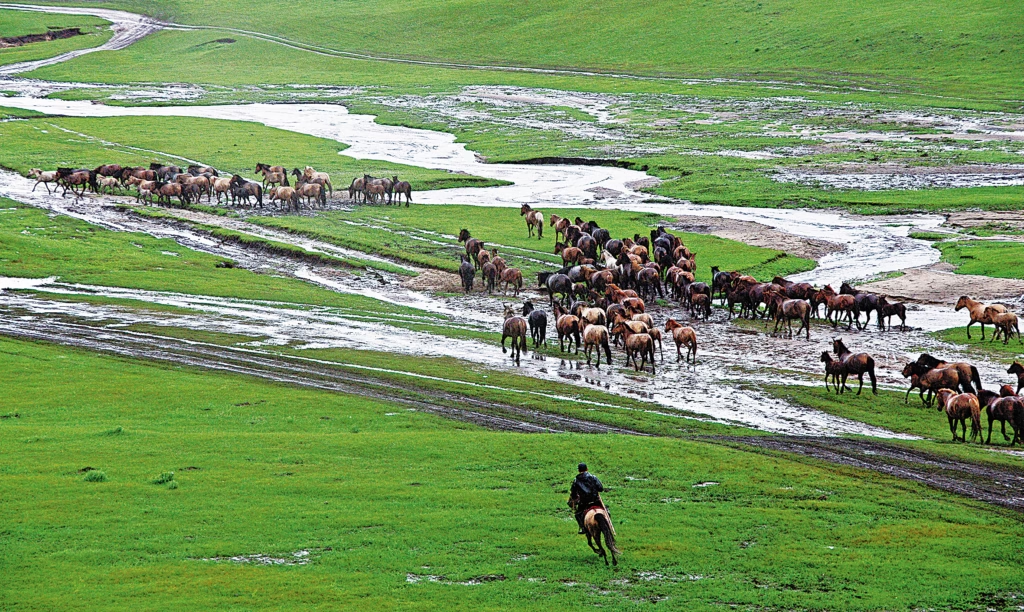

The horizon is a 360-degree promise in the Hulunbuir or Xilingol grasslands. To visit here is to understand the nomadic imperative—the need to move with your livelihood. While day-trip yurt experiences exist outside Hohhot, the true vagabond China travel experience requires going farther, perhaps arranging a multi-day horse trek with a local herding family via a community-based tourism initiative.
The sky here is a dominant continent. You’ll learn to read weather in cloud formations, find silence in the wind, and taste the profound simplicity of hand-pulled milk tea and boodog (stone-cooked meat). Digital nomad viability is low; this is a place for journal sketches, not spreadsheets. It’s an elemental reset, a stark and beautiful counterpoint to China’s dense urban centers.
7. The Mountain Sanctuaries: Sichuan’s Buddhist Trails
Cultural Authenticity Score: 9/10 | Monthly Vagabond Budget: $600-$800

Beyond Sichuan’s pandas lies a spiritual geography centered around Mount Emei and the Ganzi Tibetan Autonomous Prefecture. The pilgrim trails up Emeishan, trodden for millennia, are a moving meditation. Stay in monasteries along the ascent for a few dollars a night, sharing vegetarian meals with monks at dawn.
For more remote Buddhist culture immersion, the region around Sertar Larung Gar (one of the world’s largest Buddhist institutes) and Yading Nature Reserve offers breathtaking landscapes intertwined with devotion. The travel here is physically demanding but spiritually rewarding. The air is crisp with altitude and prayer. As independent travel grows, these sensitive regions require the vagabond’s highest degree of respect and minimal impact, principles echoed in The Economist’s latest sustainable tourism report (DA: 96).
The Responsible Vagabond’s Code: A Practical Epilogue
To travel these paths is a privilege. Your philosophy must be “take nothing but notes, leave nothing but genuine connection.“
- Learn & Listen: A few phrases in Mandarin or the local dialect bridge worlds.
- Spend Locally: Your money should flow to homestays, family restaurants, and local guides.
- Travel Lightly: Physically and digitally. Be present.
- Embrace the Pivot: Delays and detours are not obstacles; they are the itinerary.
China, for the vagabond, is the ultimate palimpsest—a nation where hypermodernity is written over layers of profound ancientness. To travel this way is to read between those lines, to find the stories still being whispered by the land itself. The journey awaits, just beyond the well-trodden wall.


