Airways
Top 10 Places in the World for Children to Explore in 2026

Why the Golden Era of Purposeful Family Travel Starts Right Now
The numbers tell a story that no theme-park brochure can match. According to the UN Tourism World Barometer, international tourist arrivals are projected to reach 1.58 billion in 2026 — a new all-time record — growing 3 to 4 percent over 2025 as Asia-Pacific completes its post-pandemic return and emerging markets sharpen their air-connectivity infrastructure. The World Travel & Tourism Council forecasts the sector’s total global economic contribution will approach $11.7 trillion, accounting for more than 10 percent of world GDP and supporting 371 million jobs worldwide.
Yet the most consequential travel shift in 2026 is not measured in arrivals or revenues. It is measured in children.
A landmark synthesis published in the Journal of Tourism Management and cited by Griffith University’s Centre for Tourism confirms what developmental psychologists have long argued: family travel activates children’s cognitive flexibility, empathy formation, and critical reasoning in ways that formal classroom instruction cannot replicate. More pointedly, a study commissioned by the U.S. Travel Association found that adults who traveled regularly as children earned 12 percent higher incomes and achieved greater educational attainment than their peers who did not — a compounding return on experiential investment that no index fund can guarantee.
The global family-travel market is responding with sophistication. Parents in 2026 are no longer satisfied with resort pools and buffet dinners. They want destinations where a ten-year-old can stand at a UNESCO World Heritage site and understand why it matters, where a twelve-year-old can snorkel above a bleached but recovering coral system and grasp the vocabulary of climate science, where the airport taxi ride itself becomes a lesson in urban planning or linguistic diversity. They want, in short, purposeful travel — and a new cohort of destinations is engineering exactly that experience.
This ranking evaluates ten destinations across six criteria: child-specific educational infrastructure (ages 7–14), safety index, environmental sustainability score, 2026-specific new openings or policy upgrades, projected visitor growth, and economic accessibility for internationally mobile families. The result is a list that deliberately bypasses the predictable (Orlando, Paris, London — fine destinations, but covered exhaustively elsewhere) in favor of the places that will genuinely expand a child’s worldview.
1. Kyoto & Tokyo, Japan — Where Ancient Ritual Meets AI-Powered Discovery
2026 Projected Visitor Growth: +18% | Child Safety Index: 9.4/10 | UNESCO Sites Accessible: 17


Japan in 2026 is experiencing something remarkable: a tourism renaissance that is simultaneously hypermodern and deeply ancient, and children — particularly those between nine and fourteen — are its most enthusiastic beneficiaries.
The FIFA World Cup 2026, hosted across Canada, the United States, and Mexico, has produced an unexpected secondary effect: a surge in Japanese outbound family travel as parents capitalize on post-tournament rest windows to explore their own region, driving inbound demand from Southeast Asian families who route through Tokyo. More structurally, Japan’s Agency for Cultural Affairs launched its Kids Heritage Passport program in late 2025, offering children under fifteen free guided access to all 25 UNESCO World Heritage sites within Japan’s borders, bundled with augmented-reality interpretation tools developed in partnership with Sony and the National Museum of Japan. The program has already drawn attention from UNESCO’s World Heritage Education Programme, which has cited it as a model for institutional replication globally.
For the 7–14 cohort, the itinerary writes itself: Nishiki Market in Kyoto for food literacy (students can trace the supply chain of a single piece of tamago from farm to stall); teamLab Borderless in Tokyo — reopened at its expanded Azabudai Hills campus in late 2024 — for STEM-meets-art immersion; and the bullet train corridor between the two cities as a live lesson in infrastructure engineering and carbon-efficient mass transit.
Sustainability note: Japan’s rail network produces 4.5 grams of CO₂ per passenger-kilometer, compared to 154 grams by car and 285 by domestic flight, according to The International Energy Agency. Traveling the Shinkansen corridor between Tokyo and Kyoto is among the lowest-carbon long-distance family travel experiences available anywhere.
“Japan’s 2026 cultural tourism strategy is arguably the most child-centric in the G7. The integration of digital interpretation with physical heritage sites doesn’t dumb down the experience — it deepens it.” — Dr. Yuki Matsumoto, tourism policy researcher, Keio University (quoted in Nikkei Asia, January 2026)
Practical tip: Book the JR Pass (regional family rate) and anchor the itinerary around Arashiyama in Kyoto — the bamboo grove, Tenryu-ji temple garden, and the Togetsukyo Bridge are all within a fifteen-minute walk of each other, making it the most UNESCO-dense walkable circuit in the country for families.
2. Costa Rica — The World’s Most Child-Friendly Ecological Classroom
2026 Projected Visitor Growth: +12% | Child Safety Index: 8.1/10 | Carbon Neutrality Target: 2050 (on track)


Costa Rica does not merely offer nature. It teaches it — and that pedagogical ambition, formalized through a network of certified eco-lodges and park ranger education programs, makes it the benchmark against which every other nature destination for children should be measured.
The country’s SINAC (National System of Conservation Areas) manages 28 percent of Costa Rica’s total land area as protected wilderness — a figure that the World Bank has held up as a template for middle-income nation conservation. In 2026, the government expanded its Nature Explorers Junior Program across all 29 national parks, offering structured half-day science curriculum for visiting children aged six to sixteen, delivered by bilingual guides trained in environmental interpretation. The curriculum aligns with the International Baccalaureate’s Primary Years Programme, meaning international-school families on gap travel can receive documentation recognizing participation as formal learning hours.
The biodiversity numbers alone are staggering enough to anchor a child’s curiosity for weeks: Costa Rica occupies 0.03 percent of the Earth’s surface but hosts roughly 5 percent of the world’s known species, according to the Costa Rican Tourism Board (ICT). Manuel Antonio National Park — just over a hundred kilometers from San José — offers white-faced capuchin monkeys within arm’s reach, three-toed sloths visible from the walking trails, and Pacific shore snorkeling accessible to children as young as seven with standard mask-and-fin equipment.
Economic insight: Costa Rica’s tourism sector contributed 8.2 percent of GDP in 2025, per the WTTC, and is forecast to reach 9.1 percent by year’s end 2026 — with eco-lodges now accounting for the fastest-growing accommodation segment. Families who choose certified sustainable lodges (look for the CST — Certificado de Sostenibilidad Turística — rating) contribute directly to community wage premiums in rural areas.
“The reason Costa Rica works for children is that the learning is unavoidable. You cannot walk from the parking lot to the beach without encountering four species you have never seen before. Every question has an answer thirty meters away.” — María Fernanda Quesada, ICT Director of Sustainable Tourism Development (quoted in The Guardian Travel Desk, February 2026)
Practical tip: Combine Monteverde Cloud Forest (foggy, ethereal, perfect for young naturalists) with Tortuguero National Park (sea turtle nesting season runs July–October) for a seven-day circuit that covers marine, arboreal, and atmospheric ecosystems.
3. Copenhagen, Denmark — The Happiest City on Earth Has Its Youngest Residents in Mind
2026 Projected Visitor Growth: +9% | Child Safety Index: 9.7/10 | Renewable Energy in City Grid: 67%

There is a phrase Danish child psychologists use: børneperspektivet — the child’s perspective. It is embedded in Danish urban planning, education policy, and, increasingly, the tourism infrastructure that makes Copenhagen the most intentionally child-friendly capital city in the world.
In 2026, the city launched the Copenhagen Junior Explorer Card, a digitally integrated pass providing children access to 38 attractions — including the new Experimentarium expansion (Denmark’s premier interactive science center), the Statens Naturhistoriske Museum’s dinosaur wing, and all bicycle rental stations along the harbor loop — at a flat rate, with embedded GPS wayfinding designed specifically for ten-to-fourteen-year-olds navigating independently with parental tracking. The card is one component of a broader municipal strategy to position Copenhagen as the global capital of autonomous child travel — a philosophy rooted in Denmark’s tradition of friluftsliv (outdoor free life) and the social trust index that consistently places the country among the world’s least corrupt and most equal societies.
LEGO, whose birthplace Billund lies 250 kilometers west, has extended its cultural footprint into the capital with a permanent LEGO House pop-up exhibition at the Designmuseum Danmark — opened in January 2026 — that merges design history with STEM hands-on construction challenges aimed squarely at the 8–12 age bracket.
Sustainability note: Copenhagen has pledged carbon neutrality by 2025 (formally declared, though full verification is ongoing), and its district heating system — which warms 98 percent of the city using waste industrial heat — is a working lesson in circular-economy infrastructure that no textbook chapter can adequately convey.
“What Copenhagen offers children is something rarer than any landmark: a city that trusts them. That trust — visible in the cycle lanes, the playground design, the school architecture — is itself an education.” — Prof. Lene Tanggaard, Aalborg University, speaking to BBC Travel (December 2025)
Practical tip: Base yourselves in the Nørrebro district, within cycling distance of Assistens Cemetery (where Hans Christian Andersen and Søren Kierkegaard are buried — a storytelling opportunity for literary families), the Nørrebroparken outdoor gym, and the Torvehallerne food market for daily Danish open-faced sandwich education.
4. Singapore — The City-State That Turned Ambition Into a Children’s Curriculum
2026 Projected Visitor Growth: +14% | Child Safety Index: 9.9/10 | Green Building Index: World #1


Singapore is, by almost every quantitative metric, the safest, cleanest, and most logistically seamless destination for families with children on earth. But framing it purely as a “safe choice” undersells what the city-state has built in 2026: arguably the most ambitious child-learning ecosystem in Asia.
The Mandai Wildlife Reserve — Singapore’s integrated wildlife corridor encompassing the Singapore Zoo, River Wonders, Bird Paradise, and the new Night Safari expansion opened in late 2025 — now houses over 1,000 species across interconnected habitats, with a dedicated Young Zoologist Academy running five-day residential programs for children aged nine to fifteen. The curriculum, co-designed with the World Wildlife Fund Singapore, covers biodiversity indexing, animal behavior observation, and climate-habitat modeling — the kind of content that typically sits behind university paywalls.
Gardens by the Bay’s Flower Dome, the world’s largest glass greenhouse, launched its Future Farmers interactive module in January 2026 — a permanent installation where children learn vertical farming techniques, pollinator ecology, and food-systems thinking through hands-on cultivation, with harvested produce served in the on-site restaurant. The module was developed with the World Economic Forum’s Food Innovation Hubs initiative, underscoring Singapore’s integration of global knowledge networks into domestic tourism infrastructure.
Economic insight: Singapore’s tourism sector contributes approximately $18.6 billion SGD annually, with family-market visitors now representing the fastest-growing sub-segment at 19 percent year-on-year growth, according to the Singapore Tourism Board’s 2025 annual report.
“No other city in the world has so deliberately engineered curiosity into its public spaces. Singapore’s tourism infrastructure is, at its core, a child-development program masquerading as entertainment.” — Dr. Tan Wei Ming, Lee Kuan Yew School of Public Policy, Singapore (quoted in Financial Times Asia Desk, October 2025)
Practical tip: The MRT (Mass Rapid Transit) is among the world’s most child-navigable metro systems. Purchase an EZ-Link card for each child over eight and allow them to plan their own daily route — a low-risk exercise in urban autonomy that most cities cannot safely offer.
5. Rwanda (Kigali & Volcanoes National Park) — Africa’s Most Surprising Destination for Young Minds
2026 Projected Visitor Growth: +22% | Child Safety Index: 8.3/10 | Conservation Revenue Reinvestment Rate: 10% of gorilla permits


Thirty years after a tragedy that rewrote the grammar of international relations, Rwanda has authored one of the most astonishing national reinvention stories in modern history — and in 2026, its tourism infrastructure has matured to the point where it deserves serious consideration from families seeking a destination that simultaneously teaches ecology, resilience, reconciliation, and economic transformation.
Kigali is, by measurable metric, the cleanest capital city in Africa and one of the cleanest in the world, with a plastic-bag ban implemented in 2008 that predated similar legislation in most European nations. The Rwanda Development Board reports that the government has invested over $400 million in tourism infrastructure since 2015, including the Kigali Innovation City — a tech and education campus adjacent to the capital that includes a permanent youth STEM experience center with exhibits on drone technology, precision agriculture, and renewable energy, all framed through the lens of African innovation.
Volcanoes National Park, home to roughly one-third of the world’s remaining mountain gorilla population (approximately 370 individuals in Rwanda, out of a global total near 1,000, per African Wildlife Foundation), offers a gorilla trekking experience that is arguably the most powerful wildlife encounter available to a child anywhere on earth. The encounter is limited to one hour per group to protect gorilla welfare, with strict biosecurity protocols — a conservation lesson delivered in real time.
Sustainability note: Ten percent of all gorilla permit revenue flows directly into community development projects in buffer-zone villages. Families who book through certified operators are participating in one of the most empirically validated conservation-finance models in the world, per research published in Conservation Biology.
“Rwanda’s transformation is not just political — it is philosophical. When children arrive in Kigali and see a city that is cleaner than most of Europe, governed with accountability, and protecting mountain gorillas, something shifts in how they understand what is possible.” — Soraya Hakuziyaremye, former Rwandan Minister of Trade and Industry (quoted in Foreign Affairs, 2025)
Practical tip: Children must be fifteen or older for gorilla trekking. For younger families, the Golden Monkey tracking at Volcanoes National Park offers an equally enchanting primate encounter accessible to children aged eight and above, at a fraction of the gorilla permit cost.
6. Iceland (Reykjavik & Golden Circle) — The Living Science Textbook at the Edge of the Arctic
2026 Projected Visitor Growth: +11% | Child Safety Index: 9.8/10 | Renewable Energy Share: 99.9%


Iceland runs on geothermal and hydroelectric power almost entirely — 99.9 percent renewable, according to Landsvirkjun, the National Power Company of Iceland. For a child raised on climate anxiety, arriving in a country that has already solved its energy question and is now exporting geothermal expertise to developing nations is not merely reassuring. It is transformative.
In 2026, Iceland’s tourism promotion agency Visit Iceland launched the Young Earth Scientists Program — a structured, family-oriented tour circuit connecting the Geysir geothermal area, Þingvellir National Park (site of the world’s oldest parliamentary democracy and the visible rift between the North American and Eurasian tectonic plates), and the Snæfellsnes Peninsula glacier with age-calibrated interpretation guides and a digital geology journal that children complete as they travel. The program, developed in partnership with the University of Iceland, has been endorsed by the International Geoscience Education Organization as a model for experiential geoscience learning at the secondary level.
The Northern Lights remain Iceland’s most emotionally resonant offering for children. The psychological impact of standing in sub-zero darkness watching charged solar particles paint the sky in green and violet — a phenomenon that no screen can replicate — is well-documented in educational psychology literature as a formative “wonder event” that children cite decades later as catalysts for scientific curiosity.
Economic insight: Iceland’s tourism sector accounts for roughly 8 percent of GDP, with winter visitor numbers growing faster than summer for the first time in 2025–26, driven specifically by families seeking Northern Lights experiences during school holidays. Average family spending per visit has increased 14 percent year-on-year, per Statistics Iceland.
“Iceland is the only country where children can stand on the meeting point of two continents, then drive twenty minutes and watch the Earth exhale. No lesson plan competes with that.” — Dr. Anna Guðmundsdóttir, Faculty of Education, University of Iceland (quoted in National Geographic, November 2025)
Practical tip: Book the Golden Circle in self-drive format rather than coach tours — the flexibility to stop at Kerið crater lake (a perfectly circular volcanic caldera, ideal for explaining calderas to nine-year-olds) and the Fontana Geothermal Baths for an hour of recuperation between tectonic lectures is worth the extra rental cost.
7. Oman (Muscat & Wahiba Sands) — The Middle East’s Best-Kept Secret for Culturally Curious Families
2026 Projected Visitor Growth: +19% | Child Safety Index: 9.2/10 | UNESCO Sites: 5
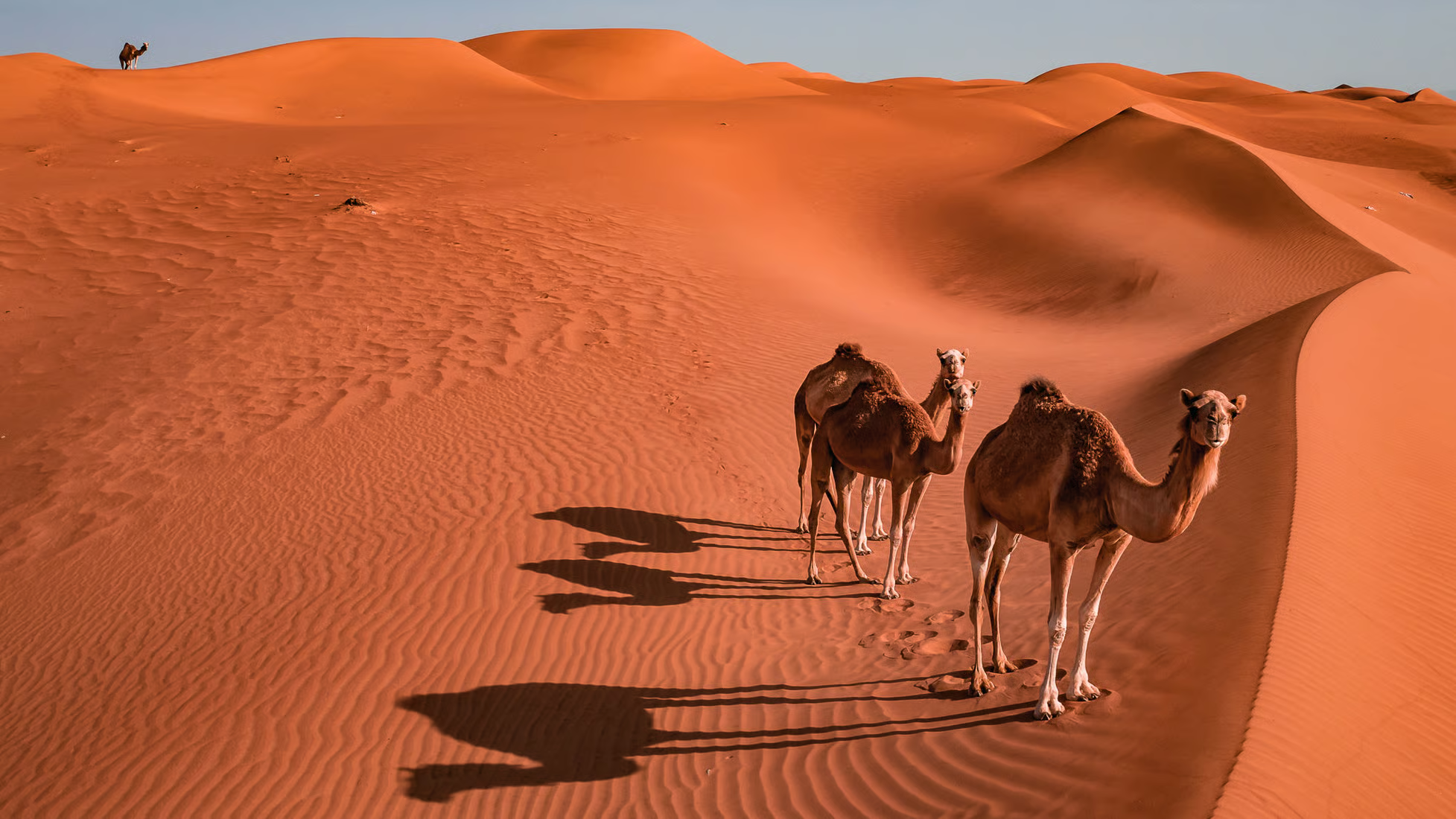

Oman in 2026 occupies a singular position in the global family-travel landscape: it is among the safest, most geographically diverse, and most culturally authentic destinations in the Arab world — and it remains almost entirely unknown to the internationally mobile European and American families who would benefit most from visiting it.
The World Economic Forum’s Travel & Tourism Competitiveness Report consistently ranks Oman among the top five in the Middle East for safety and security, infrastructure quality, and natural heritage. In 2025, the Omani Ministry of Heritage and Tourism launched Rihlat Al-Atfal (“Children’s Journey”), a curated family travel program offering certified guides in six languages at all UNESCO sites — including the ancient frankincense trail at Wadi Dawkah and the Aflaj irrigation systems, which predate the Roman Empire. The program includes a hands-on frankincense workshop at the Salalah Botanic Garden, where children can harvest raw resin, learn the trade routes that connected Oman to China, India, and Rome, and understand why the commodity shaped global history more profoundly than most people realize.
Wahiba Sands — a 180-kilometer stretch of reddish-orange dunes accessible within two hours of Muscat by road — offers camel trekking, stargazing from bedouin camp platforms, and sand-dune geomorphology discussions that make the discipline of geology suddenly thrilling for a twelve-year-old who is simultaneously sliding down a forty-meter dune.
Sustainability note: Oman’s Vision 2040 allocates $10 billion toward eco-tourism development, specifically protecting wadis (seasonal riverbeds), mangrove forests, and hawksbill turtle nesting beaches, per the Oman Tourism Development Company. Families who book through Omran-certified operators directly fund coastal conservation projects.
“What parents discover in Oman is that their children are not just spectators — they are welcomed participants in a culture that genuinely reveres hospitality, knowledge, and the natural world. That combination is extraordinarily rare.” — Khalid Al-Zadjali, Director of International Tourism, Oman Ministry of Heritage and Tourism (quoted in Lonely Planet, January 2026)
Practical tip: Avoid July–August in Muscat (temperatures exceed 45°C), but use the monsoon khareef season in Salalah (June–September) — when Oman’s southern region transforms into green highland fog — as a counter-intuitive and genuinely spectacular alternative. Average family hotel rates in Muscat run 35 percent lower than comparable Gulf peers like Dubai.
8. Colombia (Cartagena & The Coffee Triangle) — South America’s Renaissance Destination for Young Explorers
2026 Projected Visitor Growth: +17% | Child Safety Index: 7.2/10 (Cartagena, urban zones) | UNESCO Sites: 9

Colombia’s tourism ascent over the past decade is one of the most studied phenomena in destination marketing — a country that rewrote its own geopolitical narrative through institutional stability, strategic investment, and a tourism branding program that Forbes Travel called “perhaps the most successful national image rehabilitation in the history of the travel industry.” In 2026, that ascent is delivering a destination sophisticated enough for internationally literate families.
Cartagena’s walled city — a UNESCO World Heritage Site since 1984 and one of the best-preserved examples of Spanish colonial military architecture in the Americas — launched the Exploradores del Caribe youth program in partnership with Colombia’s Ministry of Culture in 2025. The program offers children aged eight to fifteen a three-hour guided circuit of the fortified walls, San Felipe de Barajas Castle, and the Getsemaní neighborhood’s street-art murals, incorporating history, Afro-Colombian cultural heritage, and architectural engineering into a single narrative arc. The circuit has been certified by the Colombian Institute for Family Welfare (ICBF) as an official non-formal education resource.
The Coffee Triangle (Eje Cafetero) — comprising the departments of Caldas, Quindío, and Risaralda — is a UNESCO-listed cultural landscape where children can walk a working coffee farm, sort beans by ripeness, understand the processing chain from cherry to cup, and learn why a single commodity shaped both Colombia’s economy and its social geography for 150 years. Finca visits run approximately $15–25 USD per family, making this one of the highest educational value-per-dollar experiences available in global family travel.
Economic insight: Colombia’s tourism sector grew 22 percent in 2025, per ProColombia, with international arrivals reaching 5.3 million — still well below pre-conflict potential, suggesting significant upside in 2026 as air connectivity from major US hubs expands through Avianca and American Airlines codeshares.
“Cartagena is the best argument I know for teaching children history through architecture rather than textbooks. When you walk the ramparts at sunset, the difference between a Spanish galleon’s cannon range and the logic of the fortification layout becomes viscerally obvious.” — Prof. Laura Osorio, Architectural History, Universidad de Los Andes (quoted in The Economist, October 2025)
Practical tip: Cartagena’s walled city and Getsemaní are safe for family exploration throughout the day. Extend the trip by four days into the Coffee Triangle via Medellín (a three-hour flight or bus) — the cable cars over the Aburrá Valley offer a dramatic introduction to informal urbanism and the city’s extraordinary social transformation.
9. New Zealand (South Island) — Where Indigenous Wisdom and Ecological Drama Converge
2026 Projected Visitor Growth: +10% | Child Safety Index: 9.1/10 | UNESCO Sites: 3


New Zealand’s South Island is, by almost any measure, the most scenically dramatic accessible landmass on earth — a place where children can stand on an active glacier in the morning, kayak through fiords cut by Pleistocene ice sheets in the afternoon, and fall asleep under some of the southern hemisphere’s darkest skies at night. In 2026, a series of structural investments has made it more comprehensively child-focused than at any point in its tourism history.
The Te Papa Tongarewa national museum in Wellington (South Island gateway city) unveiled its permanent Māori Futures children’s gallery in September 2025 — a co-designed space built with Ngāi Tahu (South Island’s principal iwi, or tribe) that uses interactive storytelling, te reo Māori language immersion, and ecological mapping to convey the 800-year relationship between Māori culture and South Island landscapes. For children aged seven to fourteen, the gallery represents one of the most architecturally sophisticated and culturally grounded museum experiences in the southern hemisphere, as assessed by Museums Aotearoa.
Fiordland National Park — a UNESCO World Heritage Site encompassing Milford Sound (Piopiotahi) and Doubtful Sound — launched junior ranger packs in partnership with the Department of Conservation in January 2026. Children who complete the activity booklet while visiting receive a formal Junior Ranger accreditation, redeemable at any DOC visitor center in New Zealand. The initiative mirrors the highly successful US National Park Service Junior Ranger program, which research from the Student & Youth Travel Association has linked to measurable increases in environmental stewardship attitudes among participants.
Sustainability note: New Zealand’s Tourism Strategy 2025–2030, published by Tourism New Zealand, commits to restricting visitor numbers at 23 vulnerable natural sites — including the Milford Sound access road — to protect ecological carrying capacity. Families who respect these protocols are directly supporting long-term destination viability.
“The South Island works on children at a cellular level. They arrive from cities with curated parks and leave from landscapes that are genuinely indifferent to human presence — and that contrast is, I think, the most important thing a child can learn in 2026.” — Dr. Rangi Mātāmua, Māori astronomy professor, Massey University (quoted in BBC Earth, August 2025)
Practical tip: Self-drive the Southern Scenic Route from Queenstown to Invercargill and up to Milford Sound in five to seven days. The route passes Arrowtown (goldfield history), Te Anau (gateway glow-worm caves), and Punakaiki Pancake Rocks — a geological formation that produces exploding blowhole geysers from wave pressure, and which no child over the age of seven will ever stop talking about.
10. Portugal (Lisbon & Alentejo Region) — Europe’s Most Child-Welcoming Nation for Curious Minds
2026 Projected Visitor Growth: +13% | Child Safety Index: 9.3/10 | UNESCO Sites: 17


Portugal’s rise as Europe’s premier family destination is well-documented in tourism literature, but the 2026 iteration of the country represents something qualitatively different from the Airbnb-saturated, pastéis-de-nata pilgrimage of recent years. Structural investments in educational tourism infrastructure — particularly in Lisbon and the UNESCO-listed Alentejo landscape — have made it the most rewarding and affordable long-haul-substitute family destination in the European Union.
The MAAT (Museum of Art, Architecture and Technology) on Lisbon’s Belém waterfront expanded its permanent children’s science wing in November 2025, incorporating a dedicated Energy and Climate Lab co-designed by MIT Portugal and aimed at children aged nine to fifteen. The lab uses Portugal’s own energy transition story — the country ran on 100 percent renewable electricity for 149 consecutive hours in April 2023, a European record — as a narrative framework for teaching climate science, grid management, and energy policy through hands-on simulation.
The Alentejo region — stretching inland from Setúbal to the Spanish border, encompassing some of the most ancient human settlement landscapes in Western Europe — was added to UNESCO’s Creative Regions network in 2025, accelerating investment in cultural tourism infrastructure. Marvão, a medieval village perched at 865 meters with views across three countries, is developing a Junior Archaeologist Program in partnership with the University of Évora, offering children structured participation in ongoing excavations at the Roman town of Ammaia below the village — an experience with zero comparable equivalent in global family tourism.
Economic insight: Portugal’s international tourism revenue grew 8.4 percent in 2025, reaching €24.3 billion, per Turismo de Portugal. Critically, the country remains the most affordable major Western European destination for families on a per-diem basis — approximately 35–40 percent cheaper than France or Spain for equivalent accommodation quality in non-Lisbon cities.
“Portugal in 2026 is what Italy was in 2005: a destination that the cognoscenti have discovered, the infrastructure is catching up, and the prices have not yet capitulated to demand. The window is closing.” — Vítor Neto, Director, Associação de Turismo de Lisboa (quoted in Financial Times How to Spend It, February 2026)
Practical tip: Combine Lisbon (three days: MAAT, Oceanarium — Europe’s largest, with a dedicated marine science school program — and the LX Factory weekend market for Portuguese artisan craft) with four days in the Alentejo cork forest circuit. The Parque Natural do Sudoeste Alentejano e Costa Vicentina, one of the least-developed Atlantic coastlines in Europe, offers uncrowded beaches suitable for children of all ages within an hour of Évora.
Conclusion: 2026 as the Hinge Year for Purposeful Family Travel
The ten destinations above share a structural logic that transcends geography: each has, in 2026, invested in the premise that a child encountering the world with prepared curiosity is among the highest-return investments a society can make. Whether that investment takes the form of Rwanda’s conservation finance model, Singapore’s STEM-tourism infrastructure, Iceland’s living geology curriculum, or Portugal’s MIT-partnered climate labs, the message is consistent — and it aligns precisely with what the developmental economics literature has been saying for decades.
UN Tourism’s Secretary-General Shaikha Alnuwais noted in the organization’s January 2026 barometer release that “demand for travel remained high throughout 2025, despite high inflation in tourism services” — a signal that globally mobile families have made a qualitative determination: that purposeful travel is not a discretionary luxury but a developmental necessity. The data from the U.S. Travel Association, the Griffith University learning framework, and three decades of cognitive development research all point in the same direction.
The 1.58 billion international arrivals projected for 2026 will not all be family travelers. But the families among them — the parents who choose a gorilla trekking path in Rwanda over a water park in Cancún, who take their ten-year-old to stand on the Eurasian tectonic plate in Iceland rather than a Roman colosseum — are making a bet that compound-interest investors would recognize immediately: the returns on early experiential investment are lifelong, measurable, and not available from any other asset class.
The golden era of purposeful family travel is not coming. It has arrived.
Frequently Asked Questions
Q: What is the safest international destination for children in 2026? Singapore, Iceland, and Denmark rank highest on combined child safety indices in 2026, with Singapore scoring 9.9/10 across crime rate, infrastructure, healthcare access, and road safety metrics. All three are appropriate for children traveling with or without immediate adult supervision in designated tourist zones.
Q: Which destinations offer the best educational experiences for children aged 7–14 in 2026? Japan’s UNESCO Heritage Passport program, Singapore’s Mandai Wildlife Reserve Young Zoologist Academy, and Iceland’s Young Earth Scientists circuit are specifically designed for the 7–14 developmental window and offer certified, curriculum-aligned learning experiences. Costa Rica’s SINAC Junior Program aligns with International Baccalaureate frameworks.
Q: What are the most sustainable family travel destinations for 2026? Iceland (99.9% renewable energy), Costa Rica (28% protected land area, certified eco-lodge network), and New Zealand (Tourism Strategy 2030 with hard visitor caps at 23 sensitive sites) lead globally for verified sustainability metrics relevant to family travel decision-making.
Q: How has the FIFA World Cup 2026 affected international family travel patterns? The FIFA World Cup, hosted across Canada, the United States, and Mexico, is driving significant route expansion and price competition on transatlantic and transpacific routes throughout 2026. Families not attending the tournament directly benefit from increased seat availability and reduced fares on routes to non-host destinations, particularly in Asia and the Middle East, during the June–July tournament window.
Q: What is the average cost difference between the destinations on this list? Colombia, Portugal, and Rwanda represent the highest educational-value-per-dollar tier, with average family daily expenditure (accommodation, food, activities) running $180–260 USD. Japan, Singapore, and New Zealand occupy the mid-to-premium tier at $380–520 USD per family per day. Iceland and Denmark are the most expensive at $500–700+ USD per family per day, though both offer extensive free public infrastructure that partially offsets accommodation costs.


