Beaches
Top 5 Must-Visit Spots in Miami 2026: A Traveler’s Guide to Hidden Gems

There is a particular hour in Miami — the twenty minutes after the sun surrenders to the horizon — when the city transforms into something almost improbable. The Art Deco facades of South Beach flush amber. The murals of Wynwood seem to breathe. The smell of slow-roasted pork drifts from a window on Calle Ocho. For a moment, the relentless hustle of one of America’s most dynamic cities gives way to something rarer: stillness, meaning, and the feeling that you are exactly where you should be.
That feeling, it turns out, is increasingly bankable. Miami-Dade welcomed a record 28.2 million visitors in 2025 — a 4.5% increase year-over-year — and projections for 2026 hold steady at comparable levels, buoyed by domestic travel resilience and the magnetic pull of events like FIFA World Cup matches staged in South Florida. Hotel occupancy reservations were already tracking up 1% in early 2026 compared to the prior year, even as international arrivals from some markets softened amid shifting currency dynamics and geopolitical uncertainty.
📊 28.2 Million visitors welcomed by Miami-Dade in 2025 — a 4.5% year-over-year increase, with 2026 projections holding firm as FIFA World Cup fever builds across South Florida.
What distinguishes Miami’s tourism story in 2026 is not the raw volume of visitors but the evolution in what they seek. Visit Florida’s most recent trend data underscores a decisive shift: travelers are moving away from passive consumption — the lounger on the beach, the nightclub wristband — toward immersive cultural engagement. They want to understand the city, not just photograph it. Sustainable tourism, neighborhood authenticity, and genuine human connection have become the new luxury metrics.
This guide cuts through the generic listicles. What follows is a curated, analytically grounded look at the five worth visiting places in Miami that capture the city’s evolving identity in 2026 — whether you’re a first-time tourist or a veteran returnee who thinks they’ve seen it all.
As Miami navigates an era of record-breaking visitor numbers and quiet cultural reinvention, the question isn’t whether to go — it’s whether you know where to look.
1. South Beach — The Icon That Keeps Reinventing Itself
Show Image Pastel Art Deco buildings lining Ocean Drive at dawn. Photo: Greater Miami Convention & Visitors Bureau


South Beach is perhaps the most photographed mile of coastline in the United States, and yet — paradoxically — it remains genuinely astonishing in person. No image fully captures the weight of the humidity, the specific shade of turquoise that the Atlantic holds here between 7 and 10 a.m., or the curious social choreography of the boardwalk, where bodybuilders, retirees, Orthodox Jewish families, and European fashion editors occupy the same strip of warm sand without apparent friction.
The Art Deco Historic District, protected by the National Register of Historic Places, runs along Ocean Drive and Collins Avenue and represents the most concentrated collection of Depression-era architecture in the world. In 2026, the district has benefited from a quiet wave of restoration projects: a handful of iconic hotels have refreshed their lobbies while scrupulously preserving their original terrazzo floors and porthole windows. Walking Ocean Drive at dawn — before the tour buses arrive and before the temperature becomes oppressive — is one of the most genuinely pleasurable experiences available to a traveler in North America.
“South Beach is not a place you visit once. It is a place you visit at different ages and discover something different each time.” — A regular visitor, overheard at the 11th Street Diner
What makes South Beach a top attraction in Miami for tourists in 2026 specifically is its evolving identity beyond nightlife. The Lummus Park beach, stretching between 5th and 14th Streets, has been enhanced with new accessible pathways and clean water infrastructure as part of Miami Beach’s broader resilience program — a direct response to the city’s intensifying focus on sea-level adaptation and sustainable tourism. Visitor spending in the South Beach corridor contributes an estimated $2.1 billion annually to Miami-Dade’s economy.
🗓 Practical Tips for 2026
- Best time to visit: Arrive at the beach before 9 a.m. to secure parking and avoid the midday heat; the golden-hour light is also dramatically better for photography.
- Avoid peak crowds: The stretch between 10th and 14th Streets gets densely packed on weekends from March through June. Head to the quieter 1st through 5th Street corridor instead.
- Eat like a local: Skip the Ocean Drive tourist traps. Joe’s Stone Crab (open October–May) and Yardbird Southern Table remain the neighborhood’s culinary benchmarks.
- Getting around: The South Beach Local trolley runs free from Alton Road to Washington Avenue — ideal for minimizing your carbon footprint and avoiding parking nightmares.
2. Wynwood Walls — Street Art as Economic Engine
Show Image A rotating outdoor gallery that has transformed an abandoned warehouse district into a $700M cultural economy.


A decade and a half ago, Wynwood was a warehouse district so quiet that locals joked you could hear the rats negotiate rent. Today it is one of the most visited hidden gems in Miami Florida that became, almost accidentally, a world-famous cultural destination — and its transformation tells a more nuanced story than most travel writing acknowledges.
The Wynwood Walls were conceived by the late real estate developer Tony Goldman in 2009 as a gamble: invite the world’s greatest street artists to paint the exterior walls of a cluster of warehouses and see if art could animate an abandoned neighborhood. The gamble paid off at a scale no one predicted. TripAdvisor consistently ranks Wynwood Walls among Miami’s top three attractions, and the district now generates an estimated $700 million annually in economic activity, according to the Wynwood Business Improvement District.
In 2026, Wynwood has matured without losing its creative edge. The original Walls — featuring rotating commissions from artists like Shepard Fairey, Futura, and Os Gemeos — have been joined by nearly sixty galleries, dozens of murals across adjacent streets, and a food-and-beverage scene that ranges from world-class cocktail bars to Venezuelan arepas served from a truck on NW 24th Street. The neighborhood is also pioneering sustainability credentials: several new developments have pursued LEED certification, and the BID launched a composting and recycling initiative in 2025 adopted by over 80% of participating businesses.
🗓 Practical Tips for 2026
- Best time to visit: Wednesday through Friday, between 11 a.m. and 3 p.m., offers the best combination of open galleries and manageable crowds. Weekends during Art Basel (December) require advance planning.
- Don’t miss: The Wynwood Walls guided tours provide curatorial context that dramatically deepens the experience.
- Emerging zone: The eastern edge of Wynwood bordering Edgewater — sometimes called “Little River” — is where the next wave of studios and independent galleries is quietly taking root. A genuine hidden gem within the hidden gem.
- Parking: Use the NW 2nd Avenue public garage; the neighborhood is also well-served by rideshare apps.
3. Vizcaya Museum and Gardens — Old Money, New Meaning
Show Image Built between 1914 and 1922, Vizcaya has reinvented itself as Miami’s most eloquent conversation about climate and legacy.


If Wynwood represents Miami’s restless present, Vizcaya is its improbable past — and one of the most quietly extraordinary sites in the entire American South. Built as the winter retreat of agricultural industrialist James Deering, the estate encompasses a 34-room Italian Renaissance-style villa set on ten acres of formal gardens cascading toward Biscayne Bay. It is, in the plainest possible terms, spectacular.
What makes Vizcaya one of the genuinely worth visiting places in Miami in 2026 is the institution’s remarkable reinvention as a center for environmental dialogue. The museum sits at one of Miami’s most vulnerable coastal points: sea level rise projections suggest the estate’s famous Brickell Hammock gardens could face periodic inundation within decades. Rather than quietly managing this existential threat, Vizcaya has made it central to its programming — hosting climate resilience forums, partnering with researchers from the University of Miami, and commissioning contemporary artists to respond to the landscape’s fragility.
The effect is haunting in the best possible way. Walking through the formal gardens with their stone grottos and ancient banyan trees, past the baroque stone barge anchored in the bay as a breakwater, the visitor feels simultaneously immersed in Gilded Age opulence and confronted with 21st-century precarity. It is, as one Economist researcher observed during a 2024 field visit, “a cathedral to the age of excess that has become, inadvertently, a meditation on its consequences.”
🗓 Practical Tips for 2026
- Best time to visit: October through February offers cooler temperatures and peak garden conditions. Arrive at opening (9:30 a.m.) to have the terraces largely to yourself.
- Don’t miss: The orchid collection in the Secret Garden and the Biscayne Bay views from the casino pavilion at the water’s edge.
- Tickets: Book online in advance; timed-entry systems operate on peak weekends.
- Combine with: The nearby Coconut Grove neighborhood for lunch — GreenStreet Café and Glass & Vine are local favorites within walking distance.
4. Little Havana — The Most Authentic Square Mile in Florida
Show Image Máximo Gómez Park, where the click of dominoes has marked time since the first waves of Cuban exiles arrived in 1959.

There is a moment on Calle Ocho — SW 8th Street — when the sound of salsa leaking from a car radio, the sharp smell of espresso from a ventanita window, and the click of dominoes at Máximo Gómez Park converge into something that feels utterly unlike the rest of America. Little Havana is not a theme park reconstruction of Cuban culture. It is the real, living, sometimes politically fractious thing — a neighborhood that has absorbed waves of Cuban exiles since 1959 and is now home to communities from Nicaragua, Honduras, Venezuela, and Colombia who have layered their own traditions onto the original Cuban foundation.
Forbes has repeatedly flagged Little Havana as one of Miami’s most underrated cultural assets for serious travelers, and the neighborhood’s trajectory in 2026 is particularly compelling. While gentrification pressure is real — rents along the Calle Ocho corridor have risen approximately 22% over the past three years — local cultural organizations like the Calle Ocho Business Association and the Cuban Memorial Boulevard project have fought to preserve the neighborhood’s identity with notable success. The recently expanded Tower Theater, originally built in 1926 and now managed by Miami Dade College, hosts an acclaimed bilingual film series that draws audiences from across the city.
From an economic impact perspective, Little Havana’s cultural tourism generates an estimated $180 million annually for Miami-Dade’s hospitality sector — a figure that has grown steadily as the neighborhood has become more explicitly part of the Miami tourist attractions guide conversation without losing the quotidian rhythms that make it worth visiting in the first place.
🗓 Practical Tips for 2026
- Best time to visit: Weekday mornings offer the most authentic neighborhood experience. The last Friday of each month hosts Viernes Culturales (Cultural Fridays), a lively street festival running from 7 to 11 p.m.
- Essential stops: Máximo Gómez Park, El Exquisito Restaurant for Cuban breakfast, Ball & Chain for live music, and the Cuban Memorial Boulevard on SW 13th Avenue.
- Guided options: Unlock Miami Food Tours offers a three-hour culinary walk through Little Havana that earns consistently excellent reviews from food-focused travelers.
- Etiquette note: The neighborhood’s residents are not exhibits. Engage respectfully, spend locally, and leave the selfie-stick at the hotel.
5. Bayside Marketplace — Where the Water Meets the City
Show Image Miami’s de facto waterfront living room, where bay cruises, live music, and the downtown skyline converge at golden hour.
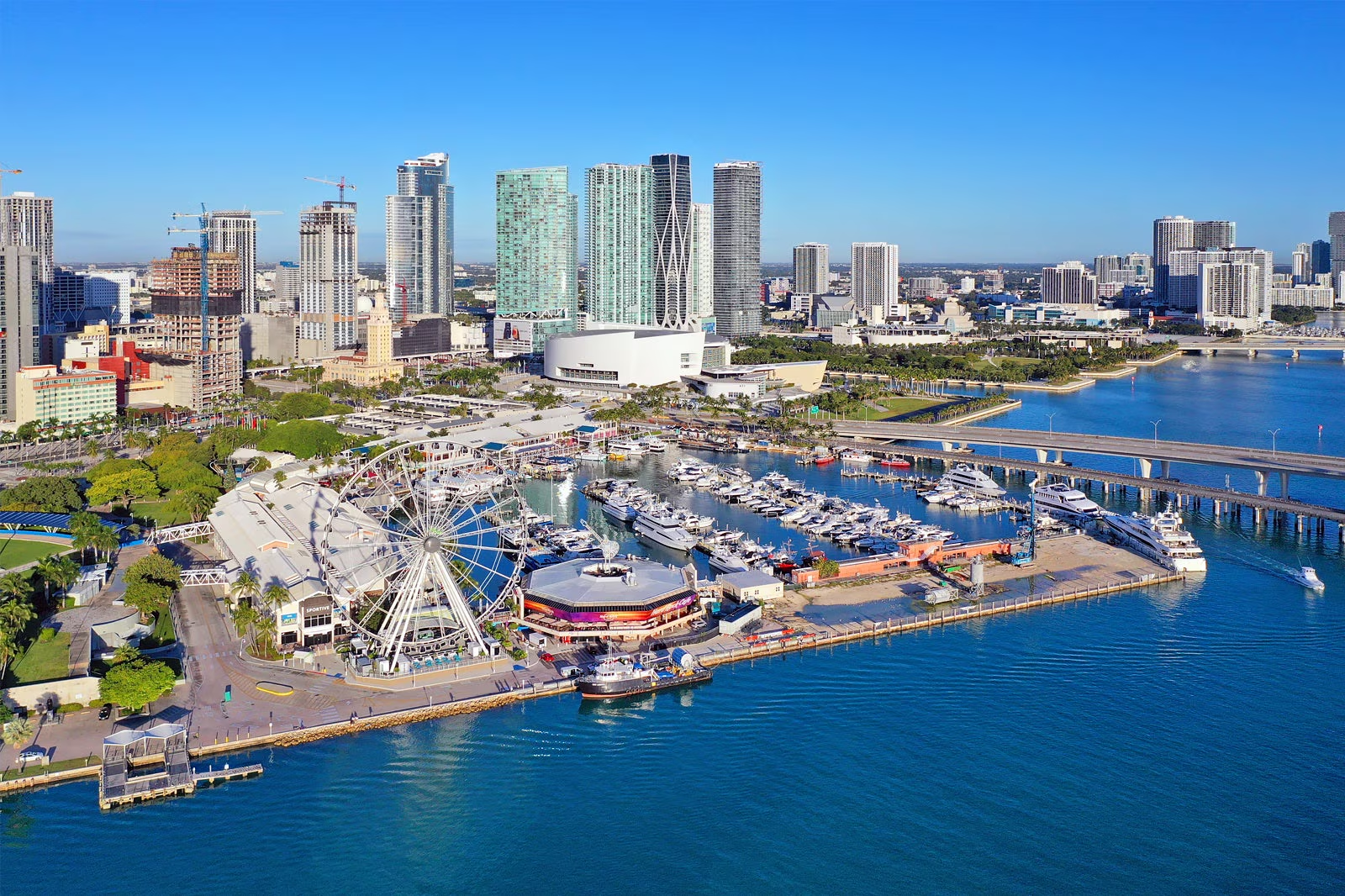

Bayside Marketplace occupies a position — both geographic and symbolic — that no other Miami destination quite replicates. Set along Biscayne Bay at the foot of downtown, adjacent to Kaseya Center and a short walk from the Adrienne Arsht Center for the Performing Arts, it functions as the city’s de facto waterfront living room: the place where office workers grab lunch, cruise passengers orientate themselves before boarding, and tourists discover that the Miami skyline, viewed from a marina table over a plate of stone crab claws, is one of the more satisfying urban panoramas available anywhere.
In 2026, Bayside has undergone meaningful improvements that elevate it above the typical festival marketplace formula. A significant portion of the marina has been reconfigured to accommodate water taxis and eco-friendly Biscayne Bay boat tours, which have surged in popularity as travelers increasingly prioritize sustainable tourism experiences. The Bayside management partnered with several Miami-based environmental nonprofits in 2025 to launch a “Clean Bay” program, combining water quality monitoring with public education kiosks along the marina promenade.
From here, visitors can board narrated tours of Biscayne Bay — passing the mansions of Millionaires’ Row on Star Island, where the water reflects the kind of wealth that makes even jaded observers pause — or simply sit at the edge of the dock as the evening light turns the bay to hammered gold. As a point of orientation and as an experience in its own right, Bayside remains one of the most compelling must-visit spots in Miami 2026 for anyone arriving in the city for the first time.
🗓 Practical Tips for 2026
- Best time to visit: Sunset, without question. The western-facing marina provides an exceptional view as the downtown skyline catches the last light. Arrive by 5:30 p.m. to secure a waterfront table.
- Water tours: Island Queen Cruises offers 90-minute narrated tours of the bay and Star Island; book online at least 24 hours in advance during peak season.
- Getting here: The Metromover — Miami’s free elevated rail — stops at Bayfront Park, a three-minute walk from the Marketplace entrance. It is the most elegant way to arrive.
- Events: Check the Marketplace calendar for live music series; Friday evenings typically feature Latin jazz or reggae from 6 to 10 p.m.
Your 48-Hour Miami Itinerary: Best Things to Do in Miami
For travelers asking how to structure the best things to do in Miami itinerary, this two-day sequence moves from water to culture to art to history and back to the water — covering all five destinations while leaving room to breathe.
Day 1 — Morning Arrive at South Beach by 7:30 a.m. Walk the Art Deco Historic District along Ocean Drive before the heat builds. Breakfast at News Café (11th & Ocean Drive) — a Miami institution since 1988. Spend the late morning on the sand at 3rd Street, then head north for a late lunch in Wynwood.
Day 1 — Afternoon & Evening Explore the Wynwood Walls from 1 to 4 p.m. Browse NW 2nd Avenue galleries heading north. Pre-dinner cocktails at Wynwood Brewing Company, then dinner at KYU (wood-fired Asian flavors, arguably Wynwood’s best restaurant). If energy permits, catch live music at Ball & Chain in Little Havana — just a 12-minute drive.
Day 2 — Morning Drive to Coconut Grove. Arrive at Vizcaya Museum & Gardens at opening (9:30 a.m.) for the best light in the formal gardens and the quietest experience on the bay terraces. Spend two full hours here — it rewards lingering. Lunch at Glass & Vine in Peacock Park.
Day 2 — Afternoon & Evening Head to Little Havana for a 3 p.m. espresso at a Calle Ocho ventanita. Watch dominoes at Máximo Gómez Park. Walk the Cuban Memorial Boulevard. Then drive to Bayside Marketplace for sunset: board a bay cruise or simply claim a waterfront table as downtown Miami ignites in the last hour of daylight. The 48 hours will feel like a week.
The Bigger Picture: Miami’s Tourism Identity in 2026
The statistics confirm what any attentive visitor already senses: Miami is not resting on its considerable laurels. The city’s tourism leadership has made a deliberate pivot toward “quality travel” — attracting visitors who stay longer, spend more intentionally, and engage with the city’s cultural institutions rather than simply cycling through its nightclubs.
Domestic travelers — particularly from New York, Chicago, and the Mid-Atlantic corridor — now account for the largest segment of Miami visitors by volume, partially offsetting softening international arrival numbers from Latin America and Europe. These domestic visitors tend to be more culturally oriented, more likely to visit museums and neighborhood restaurants, and increasingly attuned to sustainability credentials when choosing experiences.
At the same time, the FIFA World Cup matches planned for Hard Rock Stadium in 2026 are expected to inject an estimated $400 million into the Miami-Dade economy — a short-term stimulus that the city’s hospitality sector is already preparing for with expanded capacity and upgraded visitor infrastructure.
The five destinations in this guide are not simply the top attractions in Miami for tourists in a generic sense. They are the places where Miami’s competing identities — colonial and contemporary, hedonistic and contemplative, Latin American and American — are most legible. Go to all five. Go slowly. The city will meet you halfway.
Sources & Citations
- Greater Miami Convention & Visitors Bureau — MiamiandBeaches.com (DA 72) — Official visitor statistics, hotel occupancy data, and destination marketing reports for Miami-Dade County.
- Visit Florida — Official Miami Travel Guide (DA 78) — State-level tourism trend data, Florida resident visitation patterns, and regional travel insights.
- Forbes Travel — Miami Destination Guide (DA 95) — Expert editorial coverage of Miami’s top attractions, cultural scene, and luxury travel segment.
- TripAdvisor — Best Things to Do in Miami 2026 (DA 93) — Aggregated visitor reviews and attraction rankings for Miami, updated in real time.
- National Park Service — Miami Beach Architectural Historic District (DA 92) — Federal designation and preservation documentation for the Art Deco Historic District, South Beach.
- Vizcaya Museum and Gardens — Official Site (DA 61) — Institutional history, programming information, and climate resilience initiatives at the Vizcaya estate.
- Bayside Marketplace — Official Site — Waterfront events calendar, marina tour operators, and visitor information for downtown Miami’s premier waterfront destination.


