
Booking
The Untold Vagabond Tales of Northern Pakistan: Why They’re Drawing Global Wanderers in 2026

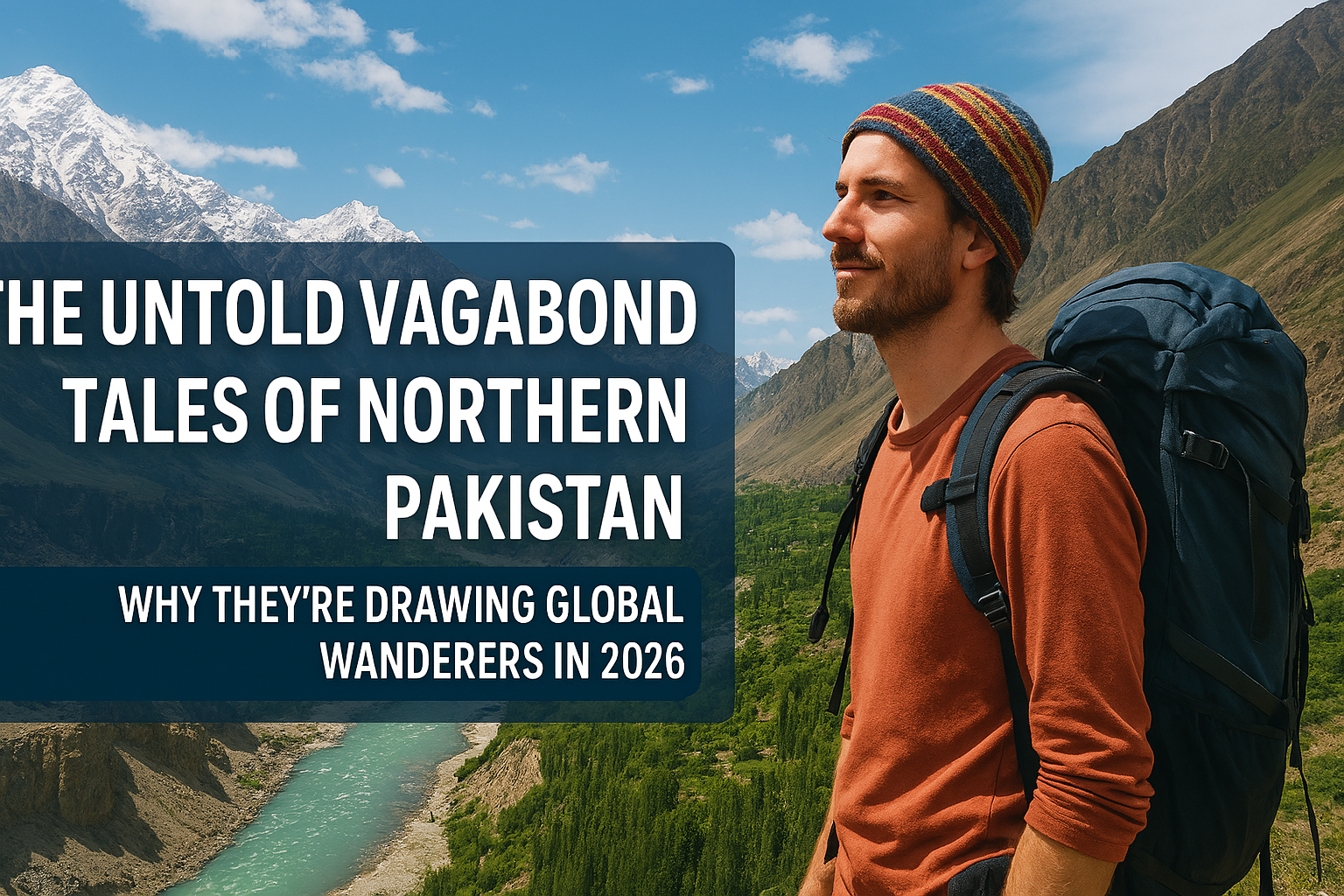
Discover inspiring stories of vagabonds from northern Pakistan’s Gilgit-Baltistan — and why international tourists can’t stop coming back to the Karakoram in 2026.
Picture this: a weathered man named Hassan, his face mapped with decades of high-altitude sun, leads a string of sure-footed donkeys along a path that hugs the edge of a glacier above the Hunza Valley. He’s not a tour guide. He’s not performing for anyone’s camera. He is, in the truest sense, a wanderer — a northern Pakistani vagabond whose family has traced these mountain routes for four generations, following grazing seasons, trading dried apricots and gemstones, and sleeping under skies so thick with stars that astronomy feels beside the point.
Stories like Hassan’s have, quietly and powerfully, become one of the world’s most compelling travel narratives. And in 2026, they are drawing international tourists to northern Pakistan in numbers that would have seemed fantastical just a few years ago.
A Tourism Boom Built on Human Stories
In 2024, Baltistan alone welcomed 486,571 domestic tourists and 21,862 international travelers — a staggering 121% increase in foreign visitors compared to 2023, when just 9,897 international tourists made the journey. PAMIR TIMES That statistic is remarkable on its own. But the question worth asking is: why? Why are travelers from Berlin, Seoul, São Paulo, and Chicago choosing the Karakoram over the Côte d’Azur?
The short answer is authenticity. The longer answer involves the nomads.
Pakistan’s northern areas — Gilgit-Baltistan, the Karakoram Highway corridor, the Hunza and Nagar valleys, and the high pastures of Deosai — are home to a tradition of seasonal migration and wandering that predates the nation-state by centuries. These are not “nomads” in a romanticized, anthropological-display sense. They are practical, resourceful, often entrepreneurial people navigating one of the most spectacular landscapes on Earth. When international tourists encounter them, something shifts. The glossy Instagram version of travel gives way to something rawer, more generous, and far more memorable.
Interest in Northern Pakistan has soared, with BBC, CNN, and the Financial Times all naming the region among the must-visit destinations for 2025 — and the momentum is carrying well into 2026. A key catalyst has been Pakistan’s streamlined e-visa system, now available to 126 nationalities, alongside the launch of direct flights between Dubai and Skardu — the first of their kind. Untamed Borders
The Gold Seekers of the Karakoram
High in the river valleys where glacial melt carries more than just water, there is a peculiar and ancient tradition: sonapani prospectors, men who pan for flecks of gold in streams that descend from the Karakoram’s flanks. Most are part-time wanderers — farmers in summer, gold-seekers in the shoulder seasons, guided by knowledge passed down through oral tradition rather than any GPS app.
Tourists who encounter these men along the upper reaches of the Gilgit River or near Yasin Valley don’t find a spectacle. They find a conversation. The sonapani prospectors are among the most hospitable people in a region already legendary for hospitality, willing to share chai and demonstrate their panning technique to anyone who stops long enough to ask. Several adventure travel operators, recognizing this, have begun incorporating “Karakoram gold route” day experiences into itineraries — not as extractive tourism, but as genuine cultural exchange where local families earn direct income from their ancestral knowledge.
This is exactly the model that responsible travel advocates argue for. Adventure travel companies that have operated in the region for nearly two decades now emphasize working closely with Gilgit-Baltistani teams, spending money in locally run guesthouses and restaurants, and using drivers and guides from the region — ensuring that tourism revenue stays in the communities it comes from. Untamed Borders
Hunza Valley Wanderers: The Digital Nomad Meets the Ancient One
Few places on earth produce the kind of cognitive dissonance that Karimabad does on a Tuesday afternoon in July. A young woman from Amsterdam has set up her laptop on the rooftop of a guesthouse, working remotely against a backdrop of Ultar Sar’s glaciated north face. A few feet away, an elderly dardic man in a flat-topped cap watches her with amused curiosity before returning to his own form of work: hand-stitching a leather saddlebag he will use when he moves his goats to higher pasture in three weeks.
Two kinds of vagabonds. One ancient. One entirely of this century. Both, remarkably, are part of what makes Hunza Valley tourism so magnetically compelling.
The Hunzakuts — as the people of the Hunza Valley are known — have always been travelers of a sort. Historically, they sat at the crossroads of the Silk Road, trading with China, Central Asia, and the Indian subcontinent. That cosmopolitan spirit never disappeared; it simply adapted. Today, Hunzakut families who once sent sons to trade in Kashgar now send them to universities in Islamabad or Lahore, and many return with skills in hospitality, eco-tourism, and digital marketing that they apply directly to their ancestral villages. The result is a tourism ecosystem that feels neither manufactured nor exploitative — it feels, as one German travel writer put it, “like being welcomed into something that was already happening before you arrived.”
The digital nomad influx into Hunza is a notable subplot. Pakistan welcomed approximately 965,000 international visitors in 2024 Hotelagio, and an increasing share of those visitors are not conventional vacationers but long-stay travelers — remote workers, travel writers, documentary filmmakers — who are choosing Hunza as a base for weeks or months at a time. The valley’s combination of reliable guesthouse infrastructure, improving cellular connectivity, dramatic scenery, and extraordinary cost-of-living advantages makes it a credible alternative to the over-touristed digital nomad circuits of Southeast Asia or the Canary Islands.
The Wakhi Herders of Chipurson: Stories That Reframe the World
Drive north from Gilgit, past the turquoise impossibility of Attabad Lake, past Gulmit and Sost, and eventually the pavement narrows to a track that leads into the Chipurson Valley — a remote corridor that ends, improbably, at the Afghan border. Here live the Wakhi, a people whose language connects them to Tajikistan, Afghanistan, and China simultaneously. They are, by geography and custom, among the most genuinely nomadic communities in South Asia.
The Wakhi move their animals — yaks, sheep, goats — vertically with the seasons, from valley floors in winter to pastures near 4,000 meters in summer. Their camps are not hardship; they are efficiency perfected over centuries. Tourists who make the effort to reach Chipurson — and it is an effort, requiring a day’s drive on roads that a standard sedan would not survive — are rewarded with one of the most profound human encounters available anywhere on the planet. Families who speak no English and have no smartphone nonetheless convey, through gesture, food, and the sheer dignity of their daily lives, something that reframes what “the good life” might actually mean.
Several Pakistani mountain guides have begun offering “Wakhi homestay” treks that spend three to five nights with herding families at altitude, with all fees paid directly to hosts. Demand has exceeded supply consistently since 2023, and the model is being studied by sustainable tourism researchers at universities in Lahore and Islamabad as a template for community-benefit adventure tourism.
The Economic Stakes Are Real — And Growing
Behind every inspiring vagabond story lies a harder economic reality. Gilgit-Baltistan has historically struggled with unemployment and limited economic diversification. Tourism is changing that calculus rapidly, and the numbers are beginning to reflect it.
Tourism is now recognized as a crucial economic driver for Gilgit-Baltistan, a region that has long contended with high unemployment. The surge in visitors is generating jobs in hospitality and tourism — sectors that are helping to improve livelihoods across local communities. Travel And Tour World The Pakistani government expects tourism to account for 7% of GDP by 2025, with the Ministry of Tourism projecting that a fully developed tourism industry could generate annual revenues of one trillion rupees. Pakistantourntravel
Pakistan’s tourism market — projected at approximately USD 4.91 billion in 2026, growing at an 11.08% compound annual rate — is no longer a footnote in South Asian economic discussions. It is a headline. And the northern areas, with their combination of world-class adventure terrain and extraordinary human stories, are driving much of that growth.
In 2024, approximately 25,000 foreign tourists visited Gilgit-Baltistan alone, representing around 50% of all international visitors to Pakistan — a concentration that speaks to how strongly the region’s reputation has pulled ahead of other parts of the country. Dailythedestination
What International Tourists Are Actually Looking For — And Finding
Ask a dozen international tourists why they came to northern Pakistan and you’ll get a dozen different answers. But listen carefully and several themes emerge consistently: relief from the predictable, desire for genuine encounter, appetite for physical challenge, and hunger for a world not yet mediated by global brands.
The vagabond stories of the northern areas deliver all of these. There’s the story of Bibi Jan, a Burusho woman in her sixties who has walked the same mountain trail between two villages every week for forty years, carrying goods on her back and news in her memory, serving as a one-woman postal service for a community that the road never quite reached. There’s the story of Rahmat, a former mountain porter who has summited K2 Base Camp over ninety times as a guide and now runs a small guesthouse in Skardu where climbers from twenty countries have signed the walls. There’s the story of the Gojali traders who still travel the ancient route over the Khunjerab Pass into China, adapting each decade — from hand-carrying goods to driving trucks to, now, facilitating cross-border e-commerce deals on WhatsApp.
These stories are not curated for tourists. They are simply the lives people live in one of the most geographically and culturally extraordinary places on Earth. That’s precisely why they work.
The Shadow Side: Over-Tourism and the Fragile Balance
No honest account of northern Pakistan’s tourism moment can ignore its tensions. The same infrastructure improvements that are making the region more accessible are also enabling the kind of volume that damages what drew visitors in the first place.
As Northern Pakistan continues to gain recognition as a must-visit destination, sustainable tourism practices are being recognized as essential to preserving the region’s natural beauty and cultural heritage. Small-group travel rather than large tour parties is increasingly seen as a way forward — one that benefits communities without causing overcrowding or disturbing the mountain environment and its wildlife. Untamed Borders
Deosai National Park, a high-altitude plateau that is one of the largest in the world and home to the endangered Himalayan brown bear, received 70,000 domestic and 4,000 international tourists in 2024. That is an extraordinary number for a fragile alpine ecosystem. Conservation researchers have raised concerns about soil compaction, waste management, and disturbance to wildlife during critical breeding seasons. The Pakistani government has begun discussions about visitor quotas and permit systems, but implementation has been uneven.
For the nomadic communities themselves, the tourism boom is a double-edged gift. Income is welcome. But the slow erosion of privacy, the pressure on young people to perform culture rather than live it, and the environmental strain on traditional grazing routes are real costs that don’t show up in visitor statistics.
2026 and Beyond: The Outlook for Pakistan Mountain Nomad Tourism
The trajectory is clear. International tourist arrivals in Pakistan are projected to reach 8 million by 2026, with the tourism sector expected to create over 5 million jobs Travellersofpakistan — figures that, if realized, would transform the national economy in ways few other policy interventions could match.
But the more interesting question is qualitative, not quantitative. Will the inspiring stories of Pakistan’s northern vagabonds — the Wakhi herders, the Hunzakut Silk Road descendants, the Karakoram gold prospectors, the high-altitude guides who have turned a subsistence skill into a global vocation — remain the living, breathing heart of what draws people here? Or will they become exhibits in an adventure theme park, their authenticity diluted by the very attention that celebrates them?
The answer depends on decisions made now, by the Pakistani government, by tour operators, by the communities themselves, and by travelers who choose to engage with genuine curiosity rather than extractive enthusiasm. The good news is that the northern areas have a long tradition of absorbing outside contact on their own terms — surviving Silk Road empires, colonial surveys, Cold War geopolitics, and now Instagram. The nomads, it turns out, are more resilient than the tourists who seek them.
If you go: travel in small groups, use local guides, stay in family-run guesthouses, pay fair prices without bargaining, and leave the plastic at home. The Karakoram will take care of the rest.
Sources consulted include reporting and data from BBC Travel, CNN Travel, Financial Times, National Geographic, the Pakistan Tourism Development Corporation, Tourist Police of Gilgit-Baltistan, the 2024 Travel & Tourism Development Index, and the World Travel and Tourism Council.
Discover more from Vagabond Diaries
Subscribe to get the latest posts sent to your email.


