
AI
AI Is Dismantling OTAs’ Hotel Booking Advantage in 2026

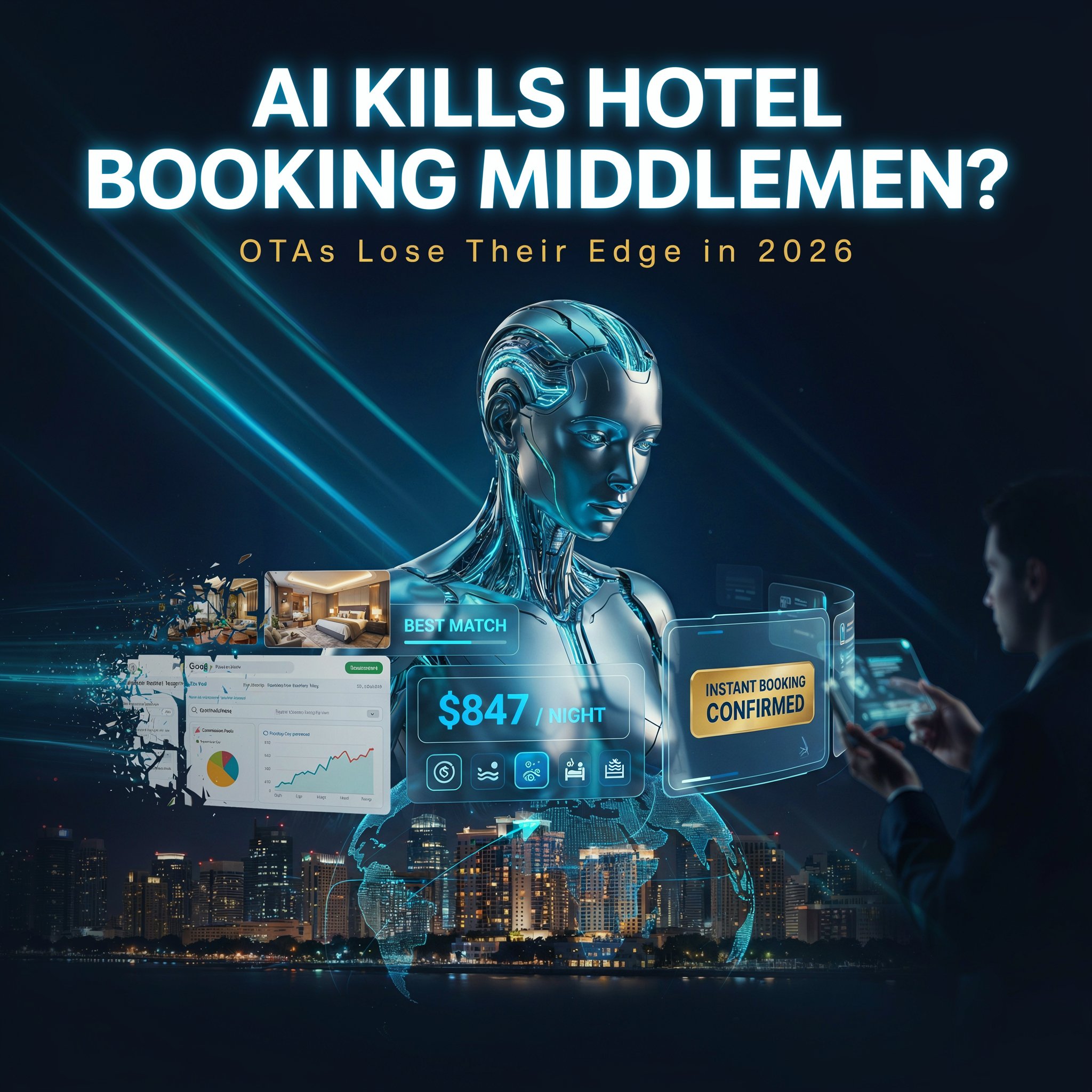
How artificial intelligence is dismantling the OTA’s first-click advantage, why 89% of hotels are optimising for yesterday’s distribution channels, and what the minority doing it right have already learned.
Every time a traveller types “boutique hotel Lisbon” into ChatGPT, the entire conversation plays out inside an AI interface. Not on Google. Not on Booking.com’s homepage. Not on any surface that Expedia Group or Booking Holdings spent a combined $14 billion in 2025 engineering to intercept. And yet, when that traveller reaches a recommendation, they are almost certainly looking at inventory owned by one of those two companies — fed into the AI through the same data relationships the OTAs built over two decades of painstaking, capital-intensive distribution work.
That is the paradox at the centre of travel’s most consequential strategic debate in 2026. Hotels are celebrating AI as a liberation technology. The platforms extracting 15–25% commission on every room they sell are using the same technology to entrench their position deeper than ever.
The Scale of the Infrastructure Gap
A new research paper from Aven Hospitality and h2c published on Skift this week quantifies what the industry already suspected: 80% of hotel chains are using AI in some capacity, but nearly all of that investment is concentrated in chatbots and automated marketing — the reactive layer of the technology stack. Only 11% of hotel organisations have deployed true AI agents capable of completing bookings, orchestrating loyalty programmes, and dynamically pricing inventory in real time.
The remaining 89%, according to the research, are “optimising for yesterday’s distribution channels while tomorrow’s are being built around them.”

Booking.com has already embedded AI across its ranking and recommendation systems. Expedia has deployed AI-driven personalisation at a scale that independent hotels cannot approach. When Booking Holdings CEO Glenn Fogel told analysts on April 28, 2026, that the company was working closely with OpenAI and Google to ensure Booking’s supply is discoverable wherever travellers begin their journey, he was not describing a future strategy. He was describing infrastructure that was already operational.
How AI Is Rewiring the Discovery Layer
The traditional hotel discovery funnel operated on search engine logic: a traveller queried Google, clicked through to an OTA or metasearch result, compared options, and booked. The OTAs owned that funnel because they had the marketing budgets — Expedia alone dedicates more than half its revenue to marketing, principally to buy visibility in Google results — and the inventory breadth to convert the traffic.
Generative AI compresses the funnel into a single conversation. When a traveller asks an AI assistant for accommodation recommendations, the system responds based on what it can access, parse, and verify — not what a brand has paid to appear at the top of a results page.
A 2026 Skift analysis found that when an AI system was asked about a specific Hyatt property, the source it cited most was not Hyatt’s own website. It was NerdWallet. The property with the broader, more consistent, more machine-readable digital footprint gave the AI system more confidence than the property with the better story but the weaker data signal base.
According to Phocuswright research, nearly four in ten travellers are already using AI tools to research and plan trips, and more than half of active travellers now use AI in some capacity. Skift’s research reinforces the trend, showing that generative AI has moved quickly into mainstream travel planning behaviour, with 56% of US leisure travellers now reporting AI use for trip planning.
The OTA Playbook, Replicated Across Every New Channel
Roger Sharp, chair of Web Travel Group and North Ridge Partners, speaking at the Skift Asia Forum in Bangkok on April 29, 2026, described the rise of AI distribution as “OTA mark two.” Incumbents won’t disappear, he said — but the same capital-efficient intermediation that rerouted billions in hotel revenue in the early 2000s is happening again, this time without the decade-long lag that allowed hotels to adapt.
The pattern is well-established. OTAs moved fast on metasearch. They moved fast on mobile. In both cases, hotels deliberated while the platforms built. The difference in 2026 is speed: the window to establish AI visibility before the competitive landscape takes permanent shape is measured in months, not years.
Sensor Tower’s 2026 State of AI Report notes that ChatGPT’s share of the AI assistant market has fallen below 50% for the first time, with Gemini now at 27.7% and rising fast. Gemini’s growth is structurally distributed — Google’s AI surface pulls from the same data relationships Google’s metasearch already had. Booking and Expedia have spent years building those relationships. A three-way split in AI discovery does not open new doors for independent hotels. It may concentrate existing OTA advantages across more platforms simultaneously.
The Economics That Created OTA Dominance Are Shifting — But Not the Way Hotels Hope
Skift Research projects the global OTA market will generate $107 billion in revenue by 2026, growing at approximately 7% annually, driven by international travel demand and continued digital adoption. Booking Holdings captured $166 billion in gross bookings in 2024 with 1.1 billion room nights. Its February 2025 announcement consolidating Booking.com, Priceline, and Agoda partnership teams into a single B2B division signalled, to those paying close attention, precisely where the company sees the next decade of growth.
Expedia’s B2B division — Expedia Partner Solutions — delivered 17% booking growth in Q2 2025 versus just 1% for Expedia’s consumer-facing business. The division’s EBITDA margin of 22.8% substantially exceeds its B2C margin of 11.1%. Skift Research estimates Booking’s B2B remains “likely half the size of Expedia’s” — but the consolidation eliminates internal competition and positions for accelerated growth in exactly the channel that will matter most as AI agents take over the booking process.
Meanwhile, Phocuswright projects that by 2030, direct digital channels will generate $409 billion in hotel bookings versus $333 billion for OTAs. The number sounds bullish for hotel independence. But the trajectory obscures a critical detail: the majority of that “direct” growth is expected to be AI-mediated, flowing through platforms the major chains cannot build and independent properties cannot afford to develop alone.
What Early Movers Are Actually Doing
The hotels that are positioning intelligently for AI distribution are not attempting to outspend the OTAs in the AI marketing arms race. They are doing something more specific and more durable: building machine-readable infrastructure.
Model Context Protocol (MCP) — the same standard powering ChatGPT Apps — is emerging as a critical integration layer. Hotels that connect their property data, real-time availability, and booking engines to MCP-compatible systems can appear in AI recommendations with live rates and direct booking links, bypassing OTA intermediation entirely for that transaction.
Langham Hospitality Group is among the early movers cited by Skift as demonstrating measurable commercial outcomes from accelerated AI implementation, specifically in staff enablement and personalisation at scale. The lesson from Langham is not the technology stack itself — it is the implementation speed and the organisational readiness that determined whether the investment translated into revenue.
The properties winning in AI discovery share three characteristics: structured data pipelines that AI systems can reliably parse; live inventory and pricing feeds connected to AI-compatible booking infrastructure; and direct loyalty relationships that give the AI system high-confidence guest preference data to personalise recommendations.
The Commission Clock Is Still Running
For the 89% of hotel organisations not yet positioned for AI-native distribution, the commercial reality is unchanged: 15–25% commission on every OTA booking, a range that has compounded against independent properties for two decades and shows no sign of reversing regardless of which channel those bookings arrive through.
WhatsApp is emerging as one of the most effective interim direct booking channels in 2026. Properties reporting conversion rates of 70–85% on WhatsApp inquiries — compared to 2–5% for website visitors — are using conversational AI to handle availability checks and booking completion within the messaging platform. This frictionless channel bypasses OTAs entirely for guests who already know the property.
Google Hotel Ads remain structurally valuable: the cost-per-click model means hotels pay a fraction of OTA commission rates for a booking completed through their own system. But Google’s AI Overviews are increasingly answering lodging queries without showing Hotel Ads at all — a structural threat to even this lower-cost channel.
The Strategic Error Hotels Keep Making
The hotel industry’s repeated strategic error is not choosing the wrong technology. It is misreading who controls the relationship the technology enables.
Hotels that listed their inventory with OTAs in the early 2000s did not gain distribution. They outsourced their demand. The properties celebrating AI liberation in 2026 are making the same category error. The sermon is identical. Only the platform changed.
AI does not begin with brand preference. It begins with retrievable evidence. The infrastructure hotels are building — structured data pipelines, MCP connectors, machine-readable content — is necessary. But what it produces, in most cases, is a more legible hotel in the discovery layer of a system whose conversion layer the OTAs already own.
The minority of hotel organisations that will benefit from the AI transition are those that treat AI readiness not as a marketing investment, but as a distribution infrastructure investment — one that establishes direct inventory connections to AI booking agents before the OTAs complete the same integration at scale. Expedia Group CEO Ariane Gorin told analysts in May 2026 that AI-powered discovery, paired with Expedia’s trusted booking and servicing infrastructure, was “a net positive” for the company’s business model. She was right. The question is whether enough hotels move fast enough to make that assessment incorrect.
FAQs
- Q: How is AI changing hotel bookings?
- A: AI shifts discovery from keyword search to conversational recommendations, favouring properties with machine-readable data and live booking connectivity over those relying on OTA marketing spend.
- Q: Will AI replace OTAs?
- A: Not in the near term. OTAs like Booking.com and Expedia are integrating directly with leading AI platforms, potentially strengthening rather than displacing their intermediary role.
- Q: What is agentic AI in travel?
- A: Agentic AI refers to AI systems capable of executing end-to-end travel tasks — researching, comparing, booking, and managing itineraries — without human intervention at each step.
Discover more from Vagabond Diaries
Subscribe to get the latest posts sent to your email.


