
Airways
Qantas Project Sunrise: Inside the World’s Longest Nonstop Flight — 22 Hours, Sydney to London

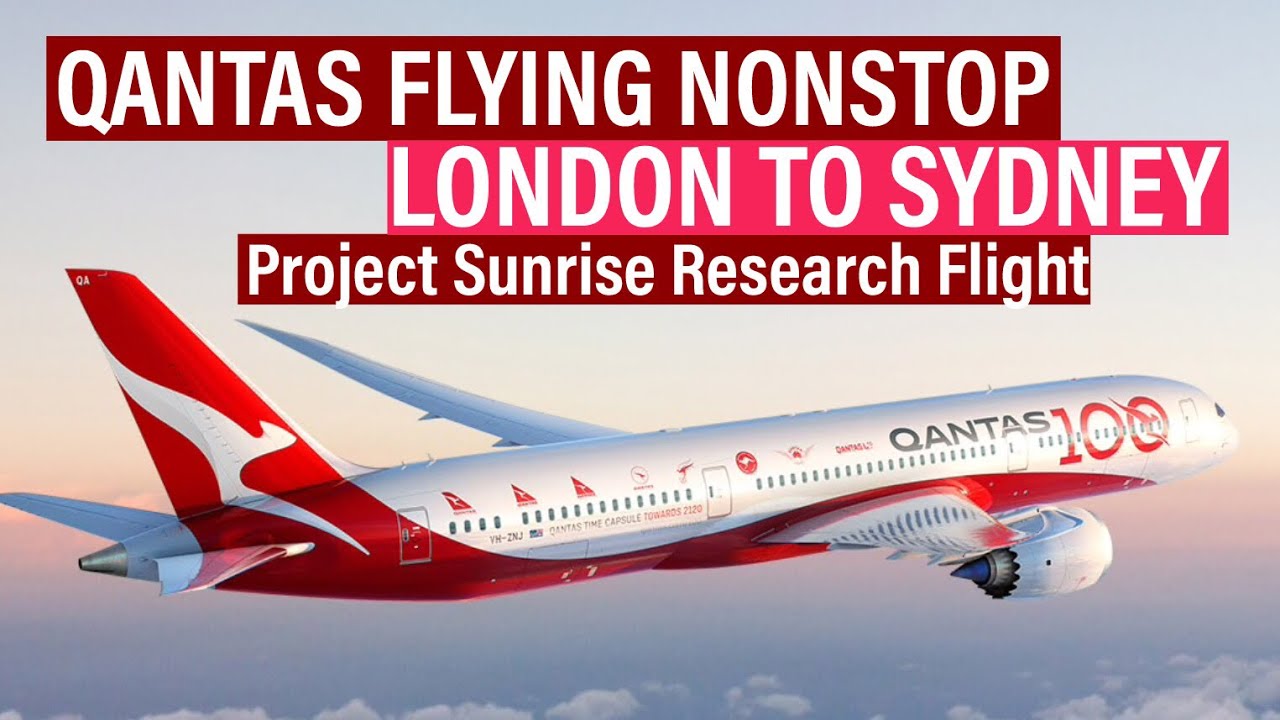
Qantas has unveiled its revolutionary Project Sunrise aircraft for the world’s longest nonstop flight — 22 hours from Sydney to London. Discover the custom Airbus A350-1000ULR, the wellness zones, flat-bed suites, and what this means for the future of long-haul travel
The Last Frontier of Commercial Aviation Has Been Conquered
For nearly a century, aviators dreamed of connecting the two endpoints of the old British Empire in a single, uninterrupted arc through the sky. The route from Sydney to London — famously known as the “Kangaroo Route” — has been one of commercial aviation’s most symbolic journeys since Qantas first flew it in 1947, stopping seven times along the way.
Now, almost eighty years later, Qantas is about to eliminate the final stop.
This week, the Australian national carrier unveiled the first of its specially modified Airbus A350-1000ULR jets at the Airbus manufacturing facility in Toulouse, France — and confirmed that nonstop commercial flights between Sydney and London will launch in October 2027, marking what aviation experts are calling the definitive end of the ultra-long-haul frontier (CNN, June 2026).
The announcement has dominated aviation and travel media globally, drawing tens of millions of reads within days. The reason is simple: this is not an incremental upgrade. It is a structural reimagining of what air travel can be.
What Is Project Sunrise? A Decade in the Making
Project Sunrise is Qantas’ long-gestating initiative to connect Australia’s east coast directly with the world’s major financial and cultural capitals — without a layover. First announced in 2017, the project survived a pandemic, supply chain crises, aircraft certification delays, and multiple false starts before this week’s milestone unveiling moved it decisively into its final phase (Sunday Guardian Live, June 2026).
The name itself carries intent. “Sunrise” is not merely a reference to Australia’s place on the global clock — it signals a new era for the airline and, arguably, for the industry.
As Qantas Group CEO Vanessa Hudson put it at the Toulouse unveiling: “Since we first flew the Kangaroo Route in 1947, where we stopped seven times on the way to London, every generation of aircraft has taken a stop out of the journey. Today, we’re taking out the last one.” (Fox Business, June 2026).
The Aircraft: Engineering a Plane That Can Stay Aloft for 22 Hours
The centerpiece of Project Sunrise is a fleet of 12 Airbus A350-1000ULR (Ultra Long Range) jets, each extensively modified beyond the standard A350-1000 configuration to enable flights of up to 22 hours (AP/US News, June 2026).
The most critical engineering modification is an additional 20,000-litre rear-centre fuel tank, paired with a completely re-engineered fuel management system designed to safely balance weight distribution across a full-day flight profile. Combined with Rolls-Royce Trent XWB-97 high-thrust engines, the resulting aircraft has a range of over 16,000 kilometres — pushing the absolute boundary of what fixed-wing commercial aviation can physically achieve (Man of Many, June 2026).
To put this in context: the current world record for the longest nonstop scheduled commercial flight is held by Singapore Airlines’ Singapore–New York route, covering 15,349 kilometres in under 19 hours. The Sydney–London Project Sunrise route covers 17,015 kilometres and will take between 19 and 22 hours depending on wind and routing conditions (AP/US News, June 2026).
The first modified aircraft has already completed its maiden test flight, with deliveries to Qantas scheduled to begin in 2027 (CNN, June 2026).
Inside the Cabin: Designed for Survival — and Comfort
A 22-hour flight presents a fundamental passenger welfare challenge that no standard cabin configuration can solve. Qantas and Airbus have responded by essentially reinventing what an aircraft interior looks like.
The most radical decision is the passenger count. While a standard Airbus A350-1000 accommodates up to 480 passengers, the Project Sunrise variant carries just 238 — nearly half the normal load — to maximize personal space and enable the wellness infrastructure required for such extended journeys (CNN, June 2026).
Cabin Classes at a Glance
First Class (6 suites, 1-1-1 layout)
Each suite offers 50% more floor space than Qantas’ existing A380 first class, featuring 57-inch-high walls, a fully closing sliding privacy door, an 80-inch flat bed entirely separate from the reclining armchair, a full-length wardrobe, and a 32-inch entertainment touchscreen with Bluetooth audio — 14 inches larger than the legacy A380 screen (Man of Many, June 2026).
Business Class (52 suites, 1-2-1 layout)
All suites feature sliding privacy doors, flat beds, and direct aisle access in every seat. Designed for the corporate traveler who would previously have routed through Singapore.
Premium Economy (40 seats, 2-4-2)
Standard long-haul premium economy configuration with added legroom optimized for extended duration.
Economy (140 seats, 3-3-3)
Access to the signature Wellbeing Zone — the feature that may ultimately define how the world perceives this aircraft.
The Wellbeing Zone: A Travel First
Perhaps the most talked-about element of Project Sunrise is not a seat class at all. Qantas has carved out an in-cabin Wellbeing Zone — a dedicated space equivalent to several rows of seats — where passengers can walk around, stretch, do guided exercises, or simply stand upright and decompress (Bloomberg, June 2026).
The zone comes stocked with snacks and beverages, is designed to encourage regular movement (a known factor in reducing DVT risk on long flights), and is positioned between economy and premium economy to give the widest range of passengers access.
Beyond the physical space, the aircraft will feature adaptive cabin lighting systems engineered to gradually synchronize with the destination’s time zone throughout the flight — a scientifically supported approach to minimizing jet lag by regulating melatonin cues via light exposure (CNN, June 2026).
The Crew Challenge: Rostering a 22-Hour Flight
Operating a flight that spans nearly an entire calendar day requires a fundamentally different crew structure. Every Project Sunrise departure will carry an expanded flight deck crew of four pilots to ensure mandatory rest cycles are maintained, with cabin crew undergoing six full days of ground training specifically focused on long-range operations and fatigue management (Man of Many, June 2026).
Qantas is currently upskilling approximately 20% of its entire long-haul pilot and cabin crew workforce for these extended duties — a training pipeline covering around 360 pilots and 1,200 cabin crew members. Pilots converting from the A330 require 32 to 40 hours of ground and simulator training, followed by six to eight dedicated line training sectors (Man of Many, June 2026).
Demand: Is There a Market for 22-Hour Economy Seats?
The commercial question that has fueled debate since Project Sunrise was first announced is whether passengers — particularly economy travelers — actually want to spend 22 consecutive hours in the air.
Qantas’ own research suggests strong appetite. The airline cited surveys showing 70% of Australians would consider booking a nonstop flight of this length, with that figure rising to 80% among premium travelers (Fox Business, June 2026). The airline also points to the precedent of its existing ultra-long-haul routes: more than 1.7 million passengers have flown its current nonstop long-haul services since 2018, including Perth–London, Perth–Rome, and Perth–Paris.
The time saving is also concrete. Project Sunrise will eliminate the traditional Singapore layover, saving passengers up to four hours of total travel time — a compelling proposition for business travelers, frequent flyers, and anyone who has sat bleary-eyed in Changi at 3 a.m. waiting for a connection.
Ticket pricing will be a premium over the Singapore-stop options, with sales opening in February 2027 (Sunday Guardian Live, June 2026).
What Comes After London: Sydney to New York
The Sydney–London debut is not the end of the Project Sunrise roadmap. Qantas has confirmed that its next ultra-long-haul nonstop service will connect Sydney to New York, a distance of 16,013 kilometres — slightly shorter than the London route, but equally transformative for Australian travelers who currently face marathon multi-stop journeys to reach the US East Coast (AP/US News, June 2026).
Additional details on the Sydney–New York route are expected next year.
A National Moment for Australia
Beyond the aviation industry, Project Sunrise carries deep cultural weight for Australia — a country that has historically occupied a geographic isolation that no high-speed rail or short hop can fix. The ability to fly nonstop from Sydney to London transforms not just individual journeys but the psychological relationship between Australia and the world.
CEO Vanessa Hudson captured this in Toulouse: “I hope that Australians will be very proud of what Qantas, their national carrier, has done. This is a test of the ingenuity within the organisation, the capability of the organisation. But it’s also about Australian character — of being able to really have a mission and go after it.” (CNN, June 2026).
FAQ: Qantas Project Sunrise Nonstop Flight
Q: When does the Qantas Project Sunrise Sydney–London nonstop flight launch?
A: October 2027, with ticket sales opening in February 2027.
Q: How long is the Qantas Sydney to London nonstop flight?
A: Between 19 and 22 hours, depending on wind and routing conditions. The route covers 17,015 kilometres (10,573 miles).
Q: What aircraft does Qantas use for Project Sunrise?
A: A specially modified Airbus A350-1000ULR (Ultra Long Range), fitted with an additional 20,000-litre fuel tank. Qantas has ordered 12 of these aircraft.
Q: How many passengers does the Project Sunrise aircraft carry?
A: Just 238 passengers — compared to up to 480 on a standard A350-1000 — to maximize space and support wellness infrastructure for the long journey.
Q: Will Project Sunrise flights have a wellness zone?
A: Yes. All cabin classes, including economy, have access to a dedicated Wellbeing Zone — an open space between economy and premium economy where passengers can stand, stretch, and access snacks and drinks throughout the flight.
Q: What is the world’s current longest nonstop flight?
A: As of mid-2026, Singapore Airlines’ Singapore–New York route (15,349 km, under 19 hours) holds the record. Qantas’ Sydney–London route will surpass it in 2027.
Discover more from Vagabond Diaries
Subscribe to get the latest posts sent to your email.


