
Airways
Skydive Dubai Soars Again After 14-Month Safety Overhaul

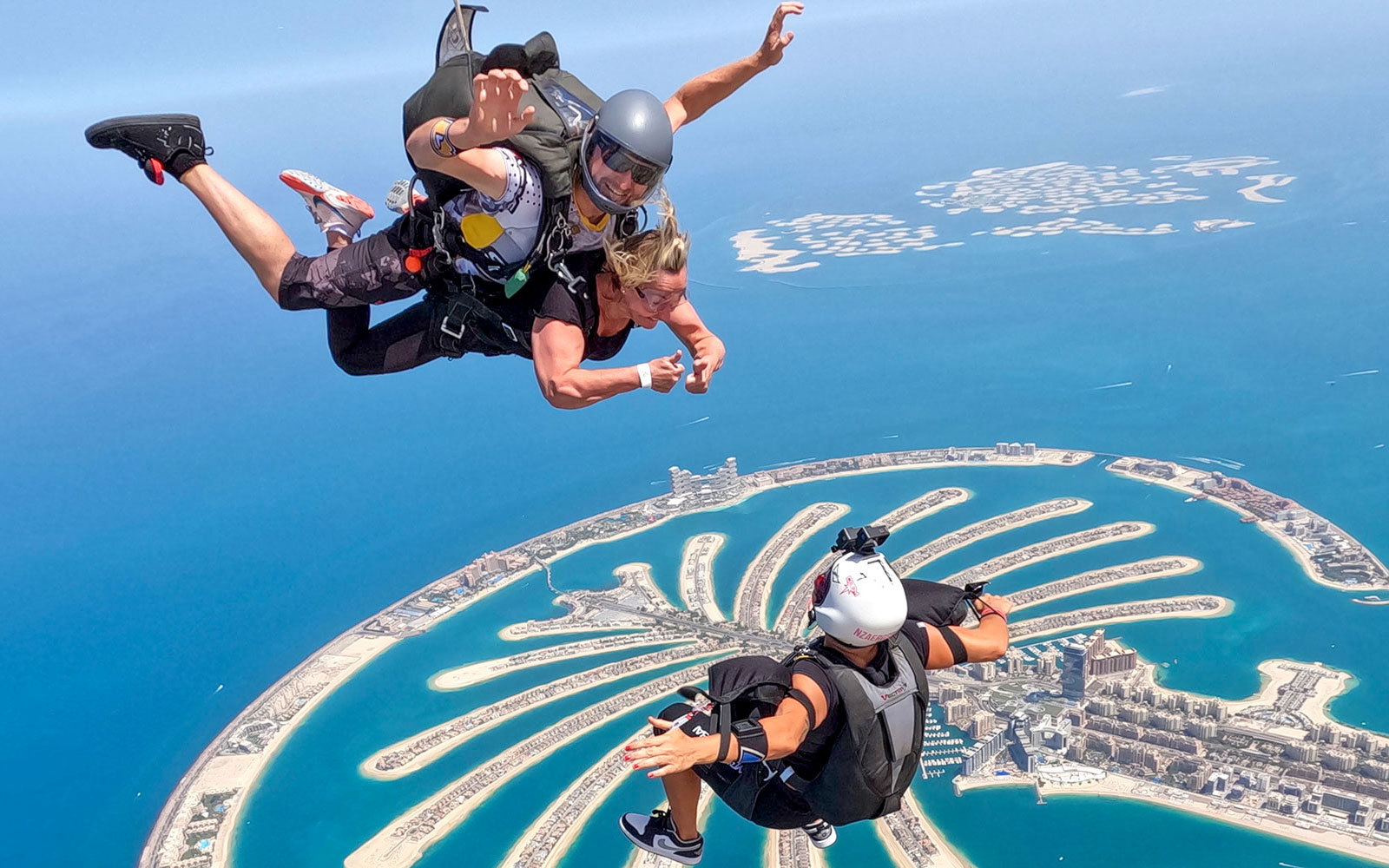
June 10, 2026 — The first body leaves the ramp at 08:04 Gulf Standard Time. It isn’t a tandem student strapped to an instructor, but Rami Al-Majali, Skydive Dubai’s chief dropzone operator, falling at 193 kilometres per hour above the Palm Jumeirah. His altimeter reads 3,900 metres. The desert below shimmers with a heat haze already pushing 37 degrees Celsius. For 67 seconds, the only thing moving faster than Al-Majali is the spreadsheet on his operations manager’s laptop, which shows 94 tandem bookings before lunch. “It’s like we never stopped,” he’d say later, a line that lands somewhere between relief and defiance.
The scene marks the operational resurrection of one of the world’s most iconic dropzones, a facility that spent 14 months grounded not by a pandemic, but by a protracted regulatory review that redefined adventure tourism governance across the United Arab Emirates. What happened at Skydive Dubai between April 2025 and June 2026 wasn’t simply a suspension and a restart. It was a stress test of the emirate’s ability to absorb a safety crisis, recalibrate its regulatory machinery, and relaunch a flagship experience sector asset without permanently scarring its global brand. The early data suggest the bet is paying off.
The Grounding That Reshaped a Sector
The General Civil Aviation Authority didn’t issue a press release when it suspended Skydive Dubai’s operating certificate on 11 April 2025. The decision followed a dual-fatality incident near the desert campus dropzone, where an experienced wingsuit pilot and a videographer collided during a canopy formation attempt. What began as an accident investigation cascaded into a full-spectrum audit of the operator’s safety management systems, instructor fatigue protocols, and equipment lifecycle tracking.
For an emirate that had positioned skydiving as a pillar of its “experiential tourism” strategy — alongside indoor skiing and deep-sea diving — the optics were treacherous. Dubai’s Department of Economy and Tourism had reported that adventure tourism contributed an estimated AED 4.2 billion to the emirate’s GDP in 2024, with skydiving operators accounting for roughly 8% of that segment. Skydive Dubai alone processed 42,000 tandem jumps the previous fiscal year, generating north of $23 million in direct revenue before ancillary spending on media, merchandise, and partner hospitality.
The regulatory response was methodical and, by international standards, severe. The GCAA imposed three conditions for recertification: a complete replacement of the operator’s parachute inventory with smart-deployment rigs equipped with automatic activation devices featuring dual-redundancy sensors; mandatory 12-hour rest intervals between instructor shifts, up from the previous 8-hour minimum; and the integration of a third-party fatigue-monitoring software platform — originally developed for Emirates Airline cockpit crews — adapted for extreme sports environments.
“The regulator wanted to send a signal,” explains Dr. Leila Hosseini, an aviation safety governance researcher at the University of Oxford’s Transport Studies Unit, whose 2025 paper on adventure sport regulation in Gulf states has become the reference point for the industry. “Dubai understood that its competitive advantage in experiential tourism isn’t just the view from 13,000 feet. It’s the perception of absolute safety. If that perception cracks, the premium pricing model collapses.” Hosseini’s research, published in the Journal of Transport Geography, found that adventure tourism operators in jurisdictions with post-incident regulatory transparency recovered booking volumes 23% faster than those in markets where authorities withheld investigation findings.
Skydive Dubai’s management didn’t wait for the regulator’s final report. By July 2025, they had appointed Captain Ahmed Al-Suwaidi, a former Emirates A380 chief pilot with zero skydiving experience, as the new director of safety and compliance. The hire was deliberate: Al-Suwaidi had spent 19 years inside the airline safety culture the GCAA wanted to replicate. His first memo to staff, dated 23 July 2025, mandated that every instructor complete the same Crew Resource Management training module used by commercial aviation pilots before they could touch a rig again.
The Economics of a High-Stakes Relaunch
The 14-month closure cost Skydive Dubai an estimated $18 million in lost revenue. But the broader economic calculus is more interesting. The dropzone sits at the intersection of three industries: tourism, media production, and real estate branding. Its tandem jumps have been featured in an estimated 47,000 YouTube videos with a combined view count exceeding 2.3 billion, according to data from social analytics platform Tubular Labs. Developers of luxury residential towers on the Palm Jumeirah routinely cite proximity to the skydive landing zone in marketing materials. When the dropzone went dark, the visual iconography that had become a de facto Dubai brand asset disappeared overnight.
The relaunch numbers, gathered from Skydive Dubai’s booking platform and corroborated by Dubai Tourism’s weekly arrivals data, tell a story of compressed demand. In the first 14 operational days, the facility processed 1,847 tandem jumps — roughly 132 per day, compared to a pre-suspension daily average of 115. The average booking lead time shrank from 23 days in 2024 to 7.4 days in June 2026, suggesting a mix of pent-up local demand and short-notice tourist bookings reacting to the reopening announcement.
The pricing strategy has shifted subtly. Pre-2025, a tandem jump over the Palm cost AED 2,199 ($599). The new pricing structure, launched 1 June 2026, adds a AED 150 “Safety Assurance Surcharge” itemised on every invoice. Marketing materials frame it not as a penalty but as a transparency mechanism: the surcharge funds the fatigue-monitoring software subscription and quarterly third-party operational audits conducted by Bureau Veritas, the French testing and inspection conglomerate whose certification is now displayed prominently on Skydive Dubai’s homepage.
Consumer response has been, by the metrics that matter, indifferent to the price increase. Conversion rates on the booking engine are running at 11.2% — marginally higher than the 10.7% average recorded in Q4 2024. “Customers aren’t price-elastic when it comes to safety reassurances that are visibly itemised,” notes Dr. Karim Saleh, a consumer behaviour economist at INSEAD’s Abu Dhabi campus, who has studied purchasing patterns in high-adrenaline experience markets. “The surcharge functions as a reverse signal. Removing it would now be the riskier marketing move.”
The Talent Equation: Who Came Back
Not everyone returned. Of Skydive Dubai’s 38 full-time tandem instructors employed in March 2025, 12 had taken positions elsewhere by the time recertification arrived — five at dropzones in Spain and Portugal, three in Thailand, and four who left the profession entirely. The attrition created both a problem and an opportunity.
The problem was institutional memory. Tandem instructing over the Palm requires a specific skill set: the ability to manage first-time jumpers from 70-plus nationalities, many of whom arrive with zero English proficiency and acute anxiety. The site-specific knowledge — wind patterns off the Gulf, the optical illusion created by the crescent-shaped breakwater that disorients students during canopy flight, the precise GPS coordinates for the beach landing zone — takes roughly 200 jumps to internalise fully.
The opportunity was workforce recalibration. Skydive Dubai’s new chief instructor, Marcus Voss, a 48-year-old German who previously managed operations at Interlaken’s Lauterbrunnen dropzone, used the recertification window to implement a hiring framework that weighted psychological screening as heavily as jump numbers. Every incoming instructor now undergoes a psychometric assessment designed by SHL, the talent measurement firm, adapted for high-consequence decision-making under physiological stress. The assessment measures response inhibition, divided attention under auditory overload, and error-recovery speed — metrics that correlate, according to SHL’s 2025 validation study, with incident-free jump records at 0.81 (p < 0.001).
“The old model said: you’ve got 5,000 jumps, you’re hired,” Voss told me during a pre-opening site walk on 4 June, the Palm’s fronds visible through the hangar doors. “The new model says: you’ve got 5,000 jumps, and we still want to know how your brain behaves when three things go wrong at 2,500 feet and your student is screaming into your ear.”
Voss’s 23-person instructor roster now includes four Emirati nationals — up from one in 2024 — reflecting a deliberate push by Skydive Dubai’s majority shareholder, the government-backed investment vehicle Dubai Holding Entertainment, to increase local participation in what has historically been an expatriate-dominated sector. The Emirati instructors completed their certification at Skydive Arizona’s training centre in Eloy under a new bilateral exchange agreement signed between the GCAA and the U.S. Federal Aviation Administration in February 2026.
The Competing Perspective: Has Regulation Overshot?
Not everyone in the global skydiving community views Dubai’s new regulatory architecture as a model worth exporting. The United States Parachute Association, which governs 228 affiliated dropzones across America, has raised concerns about what it describes as “prescriptive compliance frameworks” that may increase operator costs without proportionate safety gains.
“The data don’t support mandatory dual-redundancy AADs as a cost-effective safety intervention for professional tandem operations,” argues Dr. Peter McAllister, the USPA’s director of safety and training, citing the organisation’s 2025 incident database, which recorded 9 fatal skydiving accidents in the U.S. against roughly 3.8 million jumps — a fatality rate of 0.24 per 100,000 jumps. “Dubai’s response was politically understandable given the visibility of the incident, but we’d caution against regulatory mimicry without jurisdiction-specific cost-benefit analysis.”
The USPA’s position highlights a tension that extends beyond skydiving into the broader adventure tourism sector. The European Committee for Standardization is currently drafting a new technical specification for commercial parachuting operations, with member states divided between the prescriptive approach Dubai has adopted and a performance-based model that sets safety outcomes without mandating specific equipment configurations. Norway and Switzerland, two of Europe’s highest-volume skydiving markets, have signalled they will resist mandatory dual-sensor automatic activation device requirements on the grounds that the incremental safety benefit hasn’t been demonstrated in peer-reviewed studies.
Skydive Dubai’s management is aware of the debate but appears unmoved. “We’re not asking anyone to copy us,” Al-Suwaidi said during the recertification press conference on 28 May. “We’re demonstrating what a zero-tolerance safety culture looks like when you have the resources to implement it. Every jurisdiction will make its own calculus.”
The counterargument has merit in a narrow technical sense. The global skydiving safety record has improved dramatically over the past two decades without Dubai-style equipment mandates. Between 2000 and 2024, the U.S. fatality rate per 100,000 jumps declined from 0.83 to 0.24, driven largely by improvements in training protocols and student equipment rather than regulatory compulsion. Critics of Dubai’s approach argue that the market, not the regulator, should drive safety innovation.
Yet the market argument overlooks a structural reality. Dubai’s skydiving customer base isn’t composed of experienced sport jumpers making risk-informed decisions. It’s overwhelmingly first-timers from markets with no domestic skydiving culture, making a one-time purchase based on brand trust. In that commercial context, the calculus changes. The damage from a single high-visibility incident falls disproportionately on the entire destination’s reputation — a negative externality that individual operators may not fully price into their own risk management decisions.
What Comes Next
The recertification of Skydive Dubai doesn’t just restore a single operator’s revenue stream. It reactivates a node in a complex economic ecosystem. The aerial videography company that supplies 23 of the dropzone’s camera flyers is hiring again. The fleet transport operator that shuttles students from Dubai Marina hotels to the desert campus has added two Mercedes Sprinters to its roster. The nearby Café Rider custom motorcycle workshop, which had seen foot traffic drop 30% during the closure, recorded its busiest Saturday in 14 months on 13 June, the first weekend after reopening.
The GCAA, meanwhile, is using the Skydive Dubai recertification as a template for a broader adventure sport regulatory framework expected to be published in Q4 2026. The framework will reportedly cover paragliding, bungee jumping, and skydiving operations across all seven emirates, creating a unified standard that replaces the current patchwork of municipal approvals. Early draft language, reviewed by The Economist’s Gulf bureau, borrows heavily from the safety management system protocols developed for Skydive Dubai’s recertification process.
For the global adventure tourism industry, Dubai has become an unlikely laboratory. The question isn’t whether other jurisdictions will copy its model wholesale — most won’t — but whether elements of its approach will diffuse into the regulatory frameworks of markets where skydiving tourism is growing fastest. The GCAA has already received formal information requests from Saudi Arabia’s General Authority of Civil Aviation, which is developing adventure sport regulations for the kingdom’s giga-projects along the Red Sea coast, and from Indonesia’s Ministry of Tourism, which is seeking to standardise safety protocols for Bali’s burgeoning paragliding and skydiving sector.
At 17:32 on 13 June, Rami Al-Majali makes his 11th jump of the day. His landing is unremarkable — a two-step touchdown on the sand, student laughing, canopy collapsing behind them in the afternoon wind. A photographer captures the moment. The image won’t go viral. There’s nothing dramatic about a system functioning as designed.
That’s the point.
Discover more from Vagabond Diaries
Subscribe to get the latest posts sent to your email.


